Bees in a box: what is going on inside
At a glance
- A capped tunnel is a completed nest, not a trapped insect.
- Each tunnel holds several separate cells, one egg and one pollen loaf apiece.
- The young stay inside for months and emerge on warmth, not on a date.
- Never open, scrub or bring occupied tunnels indoors.
- Damp is what kills a brood, so dryness matters more than anything else.
Why a bee seals herself out rather than in
People often read a plugged tunnel as something gone wrong. It is the opposite: it is the clearest possible sign the box is doing its job. A female works from the back of the tunnel forwards. She packs pollen and nectar at the far end, lays one egg on it, and builds a partition — mud for mason bees, cut leaf discs for leafcutters. Then she repeats the sequence towards the entrance until the tunnel is full, and finishes with a thicker final cap. Then she leaves, and usually starts again in a neighbouring tunnel. She will never meet the bees she has just provisioned.
Inside, each egg hatches within days. The larva eats its pollen store over a few weeks, spins a cocoon, and then waits, fully formed but dormant, through autumn and winter. The order of the cells matters: the deepest are usually female and the shallowest usually male, which is the practical reason tunnel depth of roughly 10–15cm matters so much, as explained in the hole-size guide.
A year inside the box
| Season | What you see outside | What is happening inside |
|---|---|---|
| Early spring | Caps breaking open, bees hovering at the face | Last year's adults chewing out; males first, then females |
| Late spring | Constant flights, mud plugs appearing | Mason bees provisioning and sealing fresh cells |
| Summer | Neat leaf discs at tunnel mouths | Leafcutters filling the tunnels masons have vacated |
| Autumn | Nothing moving at all | Larvae finished feeding, cocoons formed |
| Winter | Still, sealed, apparently dead | Dormant adults waiting for sustained warmth |
What can go wrong inside a poor box
Three failures account for most losses, and all three are built in rather than caused by the gardener. Damp is the first: thin timber, a flush roof or open-ended cane lets water reach the cells, and mould destroys the pollen store the larva depends on. The second is an open back. If light and air pass straight through, parasitic wasps can reach sealed cells from behind and cold draughts run the length of the tunnel. The third is rough drilling, which shreds wings on repeated entries so females give up on the box before the tunnel is full.
A box that has already been used for several years also accumulates debris, mites and old cocoon remains, which is why cleaning has a place — but only at the right moment and with a light touch, as set out in how to clean a bee hotel.
What you should actually do
Very little, and that is the point. Leave capped tunnels alone. Keep the front clear of foliage. Check the fixing each autumn so winter gales cannot rock it, because repeated knocking is a real cause of abandonment. Keep it outside year round. Then spend the effort on flowers over a long season and a patch of bare damp soil for mud, which is the part that genuinely increases occupancy — see attracting bees to a bee hotel.
Choosing a box the brood survives in
Look for thick untreated timber, a roof with a real overhang, a solid rear panel, tunnels that feel smooth to a fingertip, a range of widths from roughly 2mm to 10mm, and depth of at least 10cm. The Wild Bee Hotel is built to exactly that: 19mm untreated Western red cedar, a hand-formed copper roof, hand-sanded tunnels from 2mm to 10mm and a solid back, from £39.99 with free worldwide shipping and a 30-day money-back guarantee.
Questions people ask next
Are the bees trapped in the sealed tunnels?
Should I open a sealed tunnel to look?
When do the bees come out of the box?
Can I move a box that has bees in it?
Should the box come indoors over winter?
The difference a proper box makes
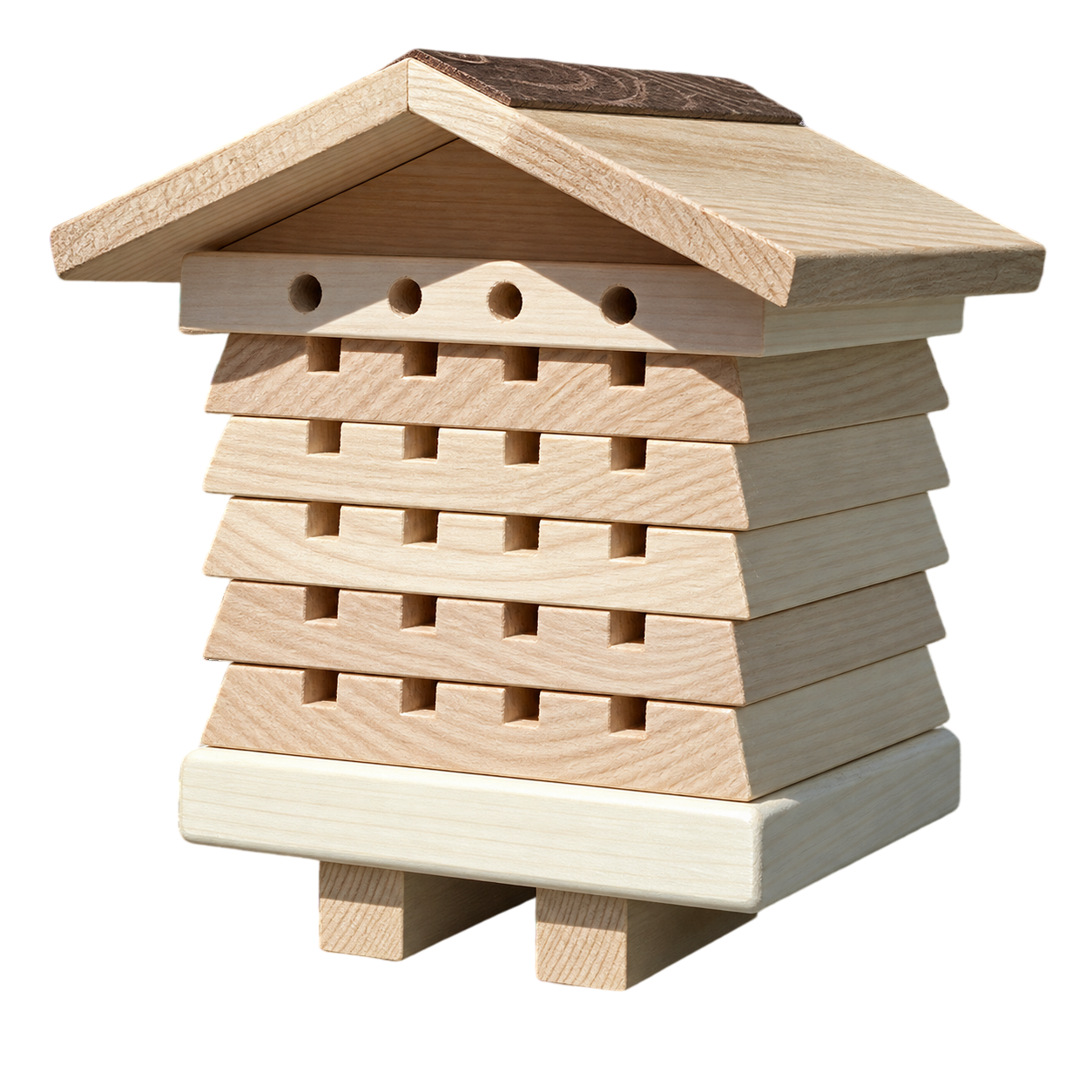
Dry tunnels of a decent depth and a sealed back are what keep a brood alive through winter instead of losing it to damp and parasites.
About Clayton Dawson
Cabinetmaker and solitary-bee keeper, and the maker of the Wild Bee Hotel. Clayton has kept red mason and leafcutter bees in his own garden for years, and every guide on this site is written and checked against what he sees in the tunnels each season rather than copied from a catalogue. Read the full story.
First published 9 July 2025 · last reviewed 20 September 2026.
What we based this on: Buglife, RHS, Wildlife Trusts.