Bee houses: choosing one that survives more than a single season
Bee house, bee hotel, bee box, bee nester — the names are interchangeable. What differs enormously is build quality, and that is what decides whether bees move in and whether their young survive to next spring.
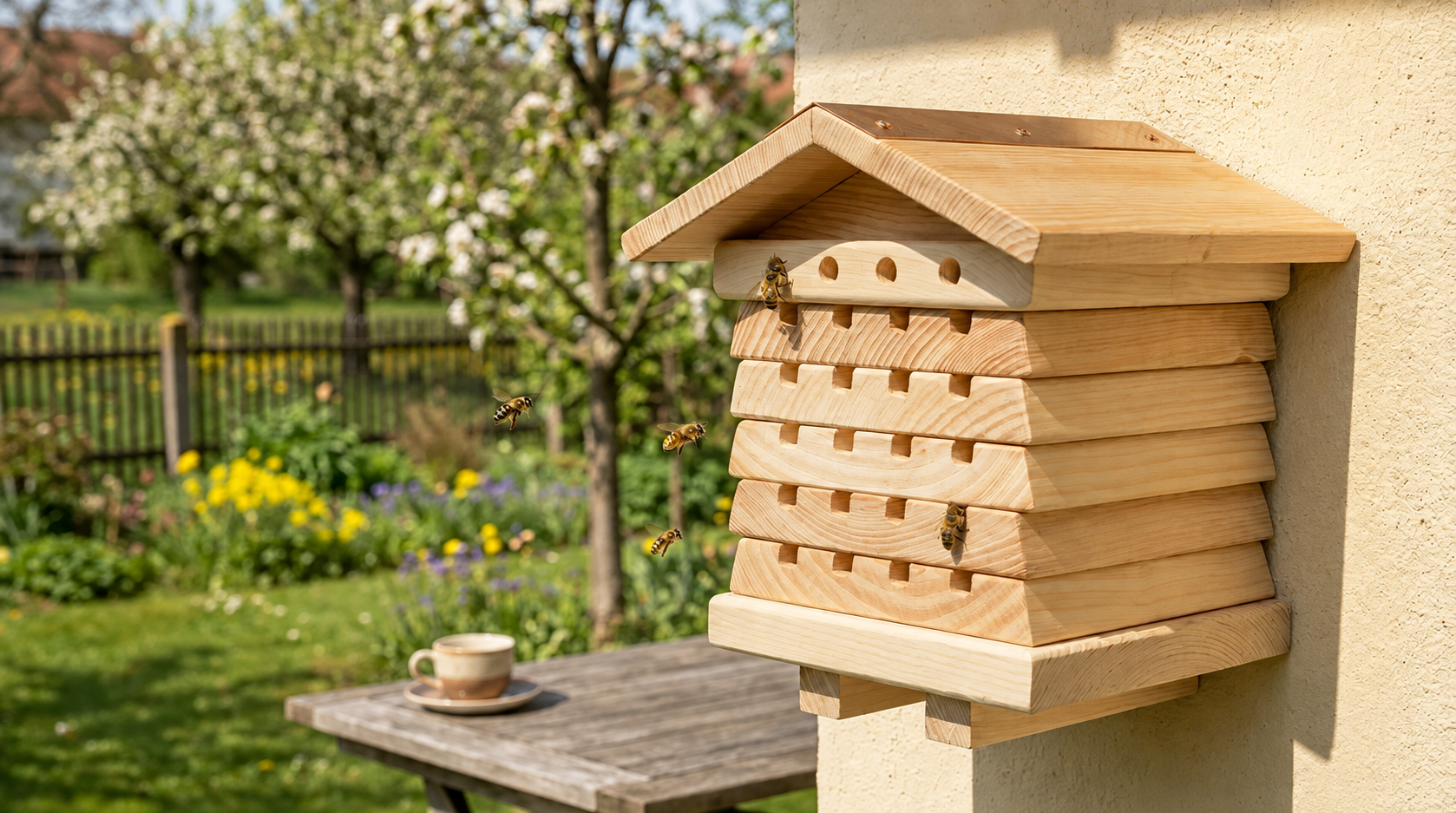
Wooden, bamboo or plastic?
Solid timber wins. Wood breathes, so the small amount of moisture a female brings in with pollen can escape rather than condensing against a sealed wall. Bamboo canes are cheap and hollow, but they are usually cut across a node, leaving a rough shelf inside, and they split along the grain after a couple of wet winters. Plastic tubes sweat badly: you often find the brood dead and mouldy in spring even though the tunnels were sealed in June.
Wall thickness matters as much as material. A thin 8mm panel tracks the outside temperature almost exactly, so the brood is cooked on a hot afternoon and chilled at 4am. A 19mm cedar wall flattens that curve out.
Size and shape
Bigger is not better. Enormous multi-storey bee houses concentrate hundreds of nests in one place, which is exactly what parasites and predators look for. Two or three well-made, modestly sized houses in different corners of the garden outperform one giant one, and if something does go wrong you have not lost everything at once.
Tunnel depth should be around 10–15cm. Shallow tunnels bias the brood towards males, because females are laid at the back where they are safest. Deeper tunnels give you a healthier mix.
Mounting a bee house properly
Fix it firmly. A house that swings in the wind gets rejected during inspection — a female will not commit to a nest site that moves while she is working. Screw it to a wall, a fence post or a stake, facing south or south-east, between one and two metres up. Keep the front clear of foliage so the entrances catch the morning sun and stay dry.
Once a tunnel is sealed, do not move the house, even by a few feet. Females navigate to a precise location; relocating a bee house mid-season means the returning bees cannot find it.
What you will see through the year
- March–April: red mason bees emerge. Males first, hovering around the entrances; females a week or so later, then nesting begins.
- May–July: the busiest period. Tunnels seal one by one — mud plugs from mason bees, neat green leaf discs from leafcutters.
- August–February: nothing visible. The larvae are developing inside and need the cold. Leave the house outdoors.
The Wild Bee Hotel as a bee house
Untreated Western red cedar with 19mm walls, tunnels hand-sanded smooth in diameters from 2mm to 10mm, a hand-formed copper roof that keeps the nesting face dry, a solid rear panel, and a steel mount that holds through a British winter. £39.99 with free worldwide shipping and 30 days to change your mind.