What size holes should a bee hotel have — and how deep?
At a glance
| Tunnel width | Who uses it |
|---|---|
| 2–4mm | Masked and yellow-faced bees, small solitary wasps — often left out of standard hotels |
| 5mm | Small leafcutters and smaller mason species |
| 6–7mm | Leafcutter bees (Megachile) |
| 8mm | Red mason bee (Osmia bicornis) — the prize tenant in most gardens |
| 9–10mm | Larger mason bees and some solitary wasps |
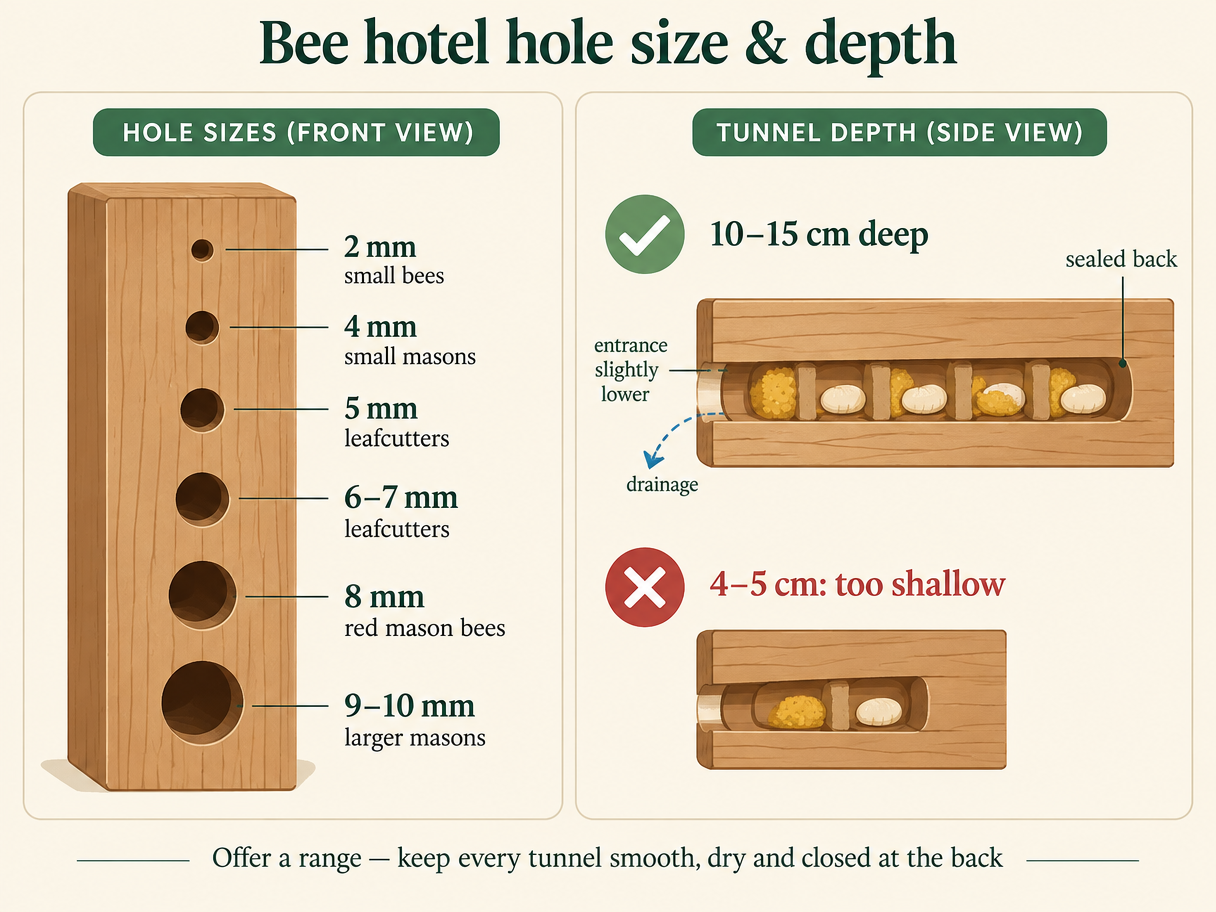
Anything much above 10mm tends to attract wasps rather than bees, and offers no real advantage even where it does. The practical answer is not one size but a spread: offer roughly 2mm to 10mm and let whichever species are flying nearby choose for themselves, which is the same logic behind how a bee hotel works in general.
Width chooses the bee; depth shapes the nest
Why diameter decides who can nest at all
A female bee cannot squeeze into a tunnel narrower than her body, and rarely bothers with one so wide that she cannot brace against the walls to work efficiently. Diameter is therefore not a matter of preference but of physical fit — it is the single strongest filter on which species a given hotel can ever host. This is why a bee hotel drilled entirely at, say, 6mm will simply never attract red mason bees no matter how well it is sited or how much sun it gets: the opportunity is closed off before siting even comes into play.
Because different species fly at different times of year — red mason bees from March to June, leafcutters from June to August — a spread of diameters also spreads the nesting activity across a longer season rather than concentrating it into a few weeks with one species.
Why depth matters just as much as width
Aim for 10–15cm. Depth decides how many cells a female can provision in a tunnel and can influence the arrangement of the brood. In several cavity-nesting species, female eggs tend to be laid deeper in the nest and male eggs nearer the entrance, although the exact pattern varies by species and conditions. A shallow tunnel of only 4–5cm leaves much less usable nesting space and may skew what is produced towards males. Deeper tunnels also place the innermost brood farther from daily temperature swings and probing birds at the entrance.
How diameter and depth work together
| Tunnel spec | Typical result |
|---|---|
| 8mm × 4–5cm | Can be used by mason bees, but leaves little room and may skew brood towards males |
| 8mm × 10–15cm | Substantially more nesting space for a fuller sequence of brood cells |
| 6mm × 10–15cm | Good for leafcutters through summer |
| 12mm+, any depth | Rarely used by bees; more likely to sit empty or attract wasps |
The details that go with the sizes
- Closed at the back. A through-hole is a corridor, not a nest, and it lets parasites in from behind — one of the clearest signs of a hotel built to look good rather than to be used.
- Smooth inside. Splinters on the tunnel wall shred wings over hundreds of entries. Run a fingertip in: if it catches, it is too rough.
- Clean entrance rims. Sawn bamboo nodes and torn drill exits both cut.
- Spaced out. Holes drilled too close together weaken the wood between them and the walls crumble over a season or two of weathering.
- Horizontal, or tilted very slightly down. Uphill tunnels collect water at the back, which is where the developing brood sits.
How to check a bee hotel before buying
- Measure more than one entrance. A small ruler or drill-gauge card should show a real spread, not rows of identical holes presented as variety.
- Confirm the usable depth. Product dimensions are not enough: ask how far the actual tunnel runs before it reaches the sealed end. The target is 10–15cm (about 4–6in).
- Inspect the back. Every nesting cavity should end in timber, a node or a fitted liner. If light passes straight through, it is not a protected nest tunnel.
- Check the finish. Entrance rims should look clean rather than torn. Where a removable tube can be touched safely, its inside should not catch a fingertip or loose fibre.
- Follow the rain path. A proper roof should project beyond the entrances, and the hotel should mount level or fractionally nose-down so water cannot collect at the back.
Solid timber, liners, reeds or bamboo?
| Nesting material | What to check | Practical trade-off |
|---|---|---|
| Drilled solid timber | Clean drilling, smooth interiors, sealed rear and enough block depth | Stable and weather-resistant when well made; poor drilling is difficult to correct |
| Paper or card liners | Snug fit, dry housing and the correct internal diameter | Easy to inspect or replace, but must be protected carefully from damp |
| Natural reeds | Unsplit stems, smooth cut ends and a natural node closing the back | Useful natural variation, though loose bundles need firm shelter and fixing |
| Bamboo | No splintered rims, no cracks, suitable bore sizes and a closed node | Durable, but wide or ragged mass-produced pieces are often unsuitable |
Millimetres, inches and local bee species
For an imperial ruler, 2mm is about 5/64in, 6mm is just under 1/4in, 8mm is close to 5/16in and 10mm is a little over 3/8in. Treat those as practical conversions rather than a reason to drill every tunnel at one nominal imperial size. The species using gardens differ by country and region, so the safest general choice is still a smooth 2–10mm spread with most capacity around 6–8mm. Local solitary-bee records can refine the balance, but variety keeps the hotel useful when you cannot identify every female flying past it.
Common mistakes buyers make
The most frequent mistake is buying a bee hotel drilled at one uniform size, usually because it looks tidy in a catalogue photo. The second is trusting a hotel with visibly rough or splintered holes because the price was low — the tunnel interior rarely gets photographed, so poor drilling is easy to hide. The third is overlooking depth altogether: a hotel can have perfect diameters and still under-perform if the tunnels are too shallow to lay a proper mix of cells. Checking all three — diameter spread, interior finish and depth — before buying avoids the three most common causes of an underused hotel, alongside getting the siting and direction right.
A neat wall of identical holes may photograph well, but it excludes every bee that does not fit that single measurement — and perfect width cannot rescue a tunnel that is rough or too shallow.
Season-by-season sizing notes
Early in spring, 8mm tunnels see the first action from red mason bees. By early summer, leafcutters begin favouring the 6–7mm range as they become active, often finishing off any tunnels the mason bees left unused. Smaller bees and solitary wasps fill in gaps at 2–5mm throughout the warmer months. A hotel that spans the full range therefore stays active for longer across the year than one built to serve a single species.
How the Wild Bee Hotel is drilled
Tiers of tunnels from 2mm to 10mm, hand-sanded inside and at the rim, set into 19mm untreated Western red cedar with a solid rear panel and a copper roof overhanging the face so the entrances stay dry. £39.99 with free worldwide shipping and a 30-day money-back guarantee.
Questions people ask next
What is the best single hole size for a bee hotel?
Why do the holes need to be sealed at the back?
Does hole depth really matter that much?
Can holes be too big?
Should the tunnels be perfectly horizontal?
What if my bee hotel only has one size of hole?
Is a 5/16-inch hole suitable for a bee hotel?
The size chart, already built in
Rather than guessing which diameters your garden needs, the Wild Bee Hotel offers the full 2mm–10mm range in one block, hand-sanded and sealed at the back.
About Clayton Dawson
Cabinetmaker and solitary-bee keeper, and the maker of the Wild Bee Hotel. Clayton has kept red mason and leafcutter bees in his own garden for years, and every guide on this site is written and checked against what he sees in the tunnels each season rather than copied from a catalogue. Read the full story.
First published 19 February 2025 · last reviewed 20 September 2026.
What we based this on: Bumblebee Conservation Trust — bee nest boxes, Buglife, RHS.