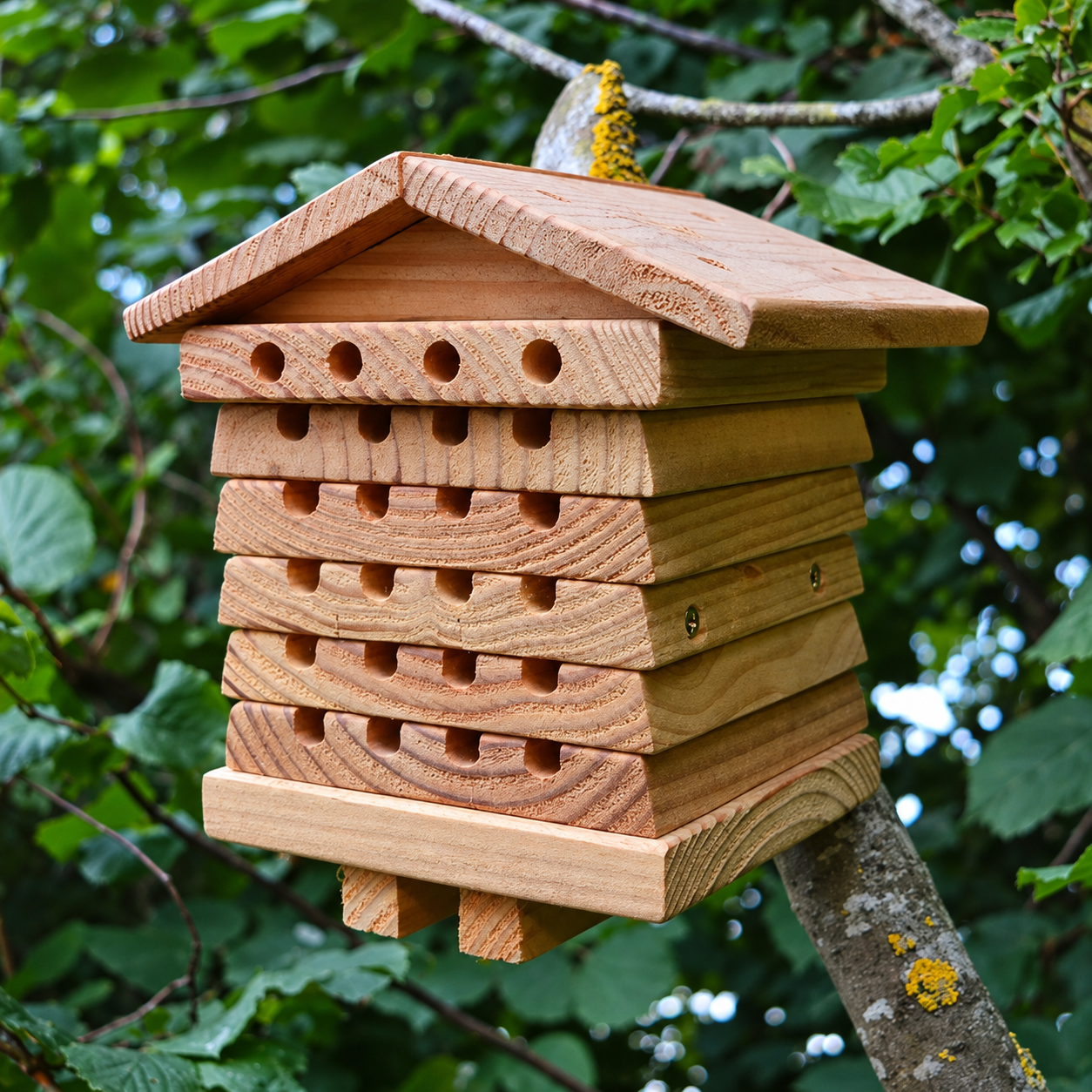
What is a bee hotel?
At a glance
- A set of dry, dead-end tunnels for solitary, non-colonial bees — not a beehive.
- Tunnel widths typically span 2mm to 10mm to suit different species.
- Each female works alone, laying eggs in a line and sealing the tunnel behind her.
- No honey, no queen, no swarm, and essentially no sting risk in normal use.
- Left outside year-round; occupied tunnels should never be disturbed.
Why "hotel" is the right word, not "hive"
Roughly 90% of the UK's bee species are solitary rather than social. There is no worker caste, no queen laying thousands of eggs, and no stockpile of honey worth defending — each female mates, then does every job herself: finding a tunnel, foraging for pollen and nectar, laying an egg, and sealing the cell. A bee hotel is named accurately: it is short-term, self-catering accommodation for a long list of individual guests who never meet each other, rather than a managed hive with a single resident colony.
In the wild, those tunnels already exist as old beetle borings in dead wood, the hollow stems of last year's brambles and teasels, and crumbling soft mortar in old walls. Modern gardens and tidy municipal planting remove most of that habitat: dead wood gets cleared, stems get cut back in fashion, and repointed walls seal up their gaps. A bee hotel is a deliberate, concentrated replacement for something that used to be scattered incidentally through the landscape.
How the nesting process actually works
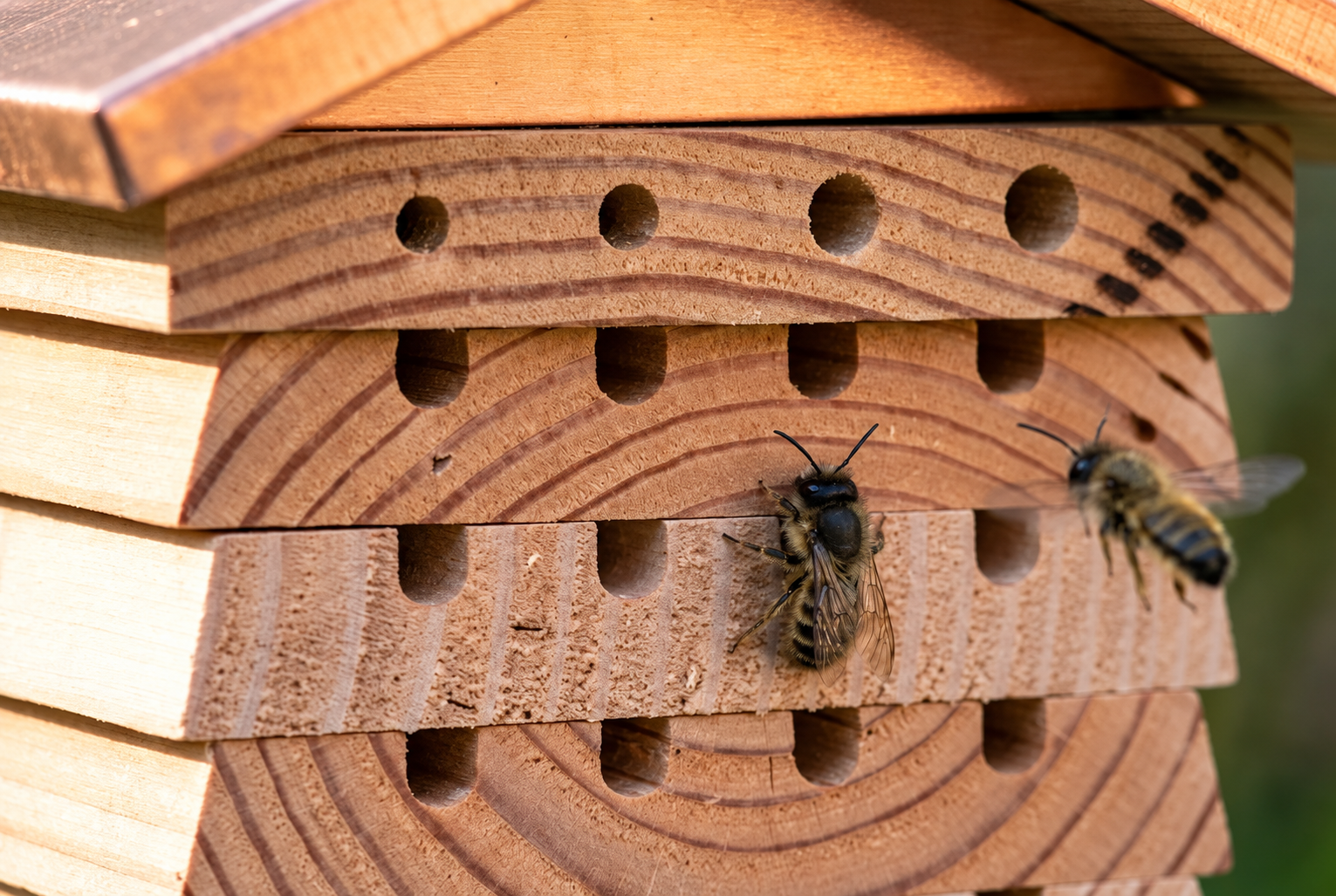
A female arrives at an empty tunnel, often after inspecting several, and begins provisioning it. She flies out repeatedly to collect pollen and nectar, rolling it into a small loaf at the back of the tunnel, then lays a single egg on top of it and seals that cell with a wall — mud for red mason bees, snipped leaf discs for leafcutters. She repeats this along the tunnel's length, usually laying female eggs at the back and male eggs nearer the entrance, before capping the whole tunnel once it is full. That sequence, repeated across dozens of tunnels and weeks of good flying weather, is the entire mechanism a bee hotel exists to support.
Understanding hole sizes helps explain why one fixed diameter never suits every visitor — see what size holes a bee hotel needs for the detail. The reason depth matters just as much as width is that the ratio of female to male eggs depends on how much usable tunnel length is behind the entrance.
Which species you can expect to see
| Species | Season | Tunnel width it favours |
|---|---|---|
| Red mason bee (Osmia bicornis) | March–June | About 8mm |
| Leafcutter bees (Megachile spp.) | June–August | 6–7mm |
| Small masked and yellow-faced bees | Spring–summer | 2–4mm |
| Solitary hunting wasps (harmless to people) | Summer | Various, often smaller widths |
Which of these turn up depends entirely on what is already flying locally, so a hotel with a single tunnel size will always miss visitors that a mixed spread would have caught.
What a bee hotel is not
- Not a beehive — there is no honey, no colony, and nothing to harvest.
- Not a bird box or a general "bug hotel" habitat pile, though some overlap in casual use.
- Not a meaningful sting risk; solitary females have little reason to be defensive.
- Not something that needs feeding, cleaning weekly, or daily attention of any kind.
What separates a good bee hotel from a decorative one
Plenty of garden-centre bee hotels are bought as ornaments and never used, and the reasons are almost always physical rather than about placement. Thin plywood lets damp through in a single wet week. Drilled holes left rough inside shred a bee's wings after enough entries and exits. A hollow back lets parasitic wasps reach the brood from behind. None of that is visible on a shelf, which is exactly why so many hotels look fine and sit empty. The traits that matter are dry, thick timber; a roof that genuinely overhangs the tunnel openings; smooth-sanded interiors and rims; a solid back panel; and a spread of tunnel widths rather than one size.
A year in the life of a bee hotel
Spring brings the first mason bees, hovering at the tunnel face before reversing in with a pollen load. By early summer the entrances start to show mud or leaf caps as tunnels fill and seal. Through late summer, leafcutters take over the vacant tunnels. Autumn and winter look completely inactive from the outside, but the next generation is developing inside the sealed cells, which is why a hotel should stay outdoors, undisturbed, through the cold months — it is covered in more detail in the year-round care guide. The following spring, the cycle restarts as the new adults chew their way out.
What to look for if you are buying one
Check tunnel widths span roughly 2mm to 10mm rather than one uniform size, look for a back panel rather than a through-hole, run a finger inside a few tunnels to check they are smooth, and check the roof genuinely overhangs the face rather than sitting flush with it. Untreated timber avoids any solvent smell that could put nesting females off. The Wild Bee Hotel is built to that exact list: 19mm untreated Western red cedar, a hand-formed copper roof, tunnels from 2mm to 10mm hand-sanded inside and at the rim, and a solid rear panel, for £39.99 with free worldwide shipping and a 30-day money-back guarantee.
Questions people ask next
Is a bee hotel the same as a beehive?
Will a bee hotel attract wasps?
Do the bees living in a bee hotel sting?
How many bees can live in one bee hotel?
Do I need to do anything once bees move in?
Can a bee hotel be used every year?
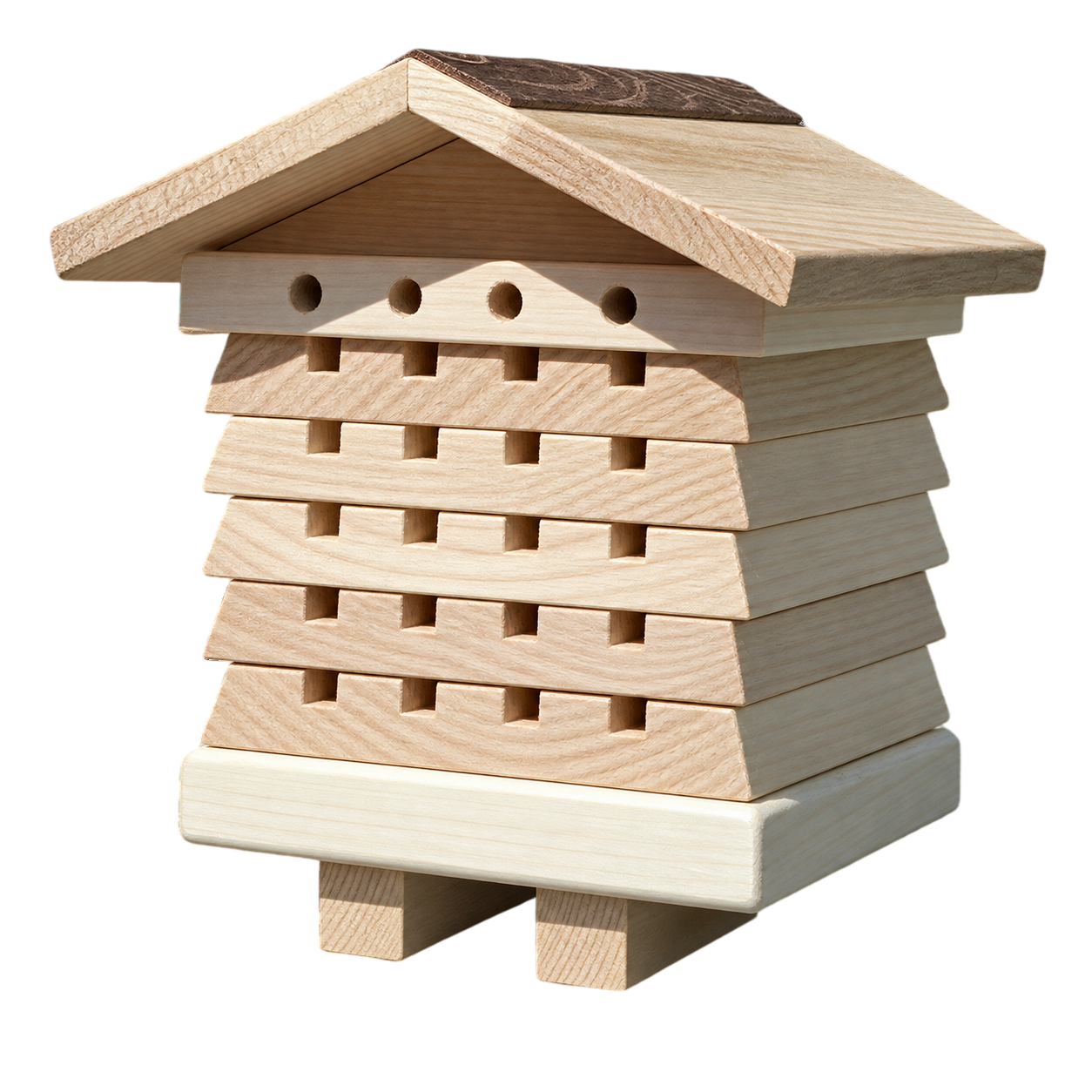
Built to the spec this page describes
Every feature mentioned above — dry tunnels, a spread of widths, a sealed back, untreated timber — is standard on the Wild Bee Hotel, not an upgrade.
About Clayton Dawson
Cabinetmaker and solitary-bee keeper, and the maker of the Wild Bee Hotel. Clayton has kept red mason and leafcutter bees in his own garden for years, and every guide on this site is written and checked against what he sees in the tunnels each season rather than copied from a catalogue. Read the full story.
First published 8 April 2025 · last reviewed 2 July 2026.
What we based this on: Bumblebee Conservation Trust, Buglife, RHS.