Bee hotels: what separates an occupied one from garden decoration
A bee hotel is a block of dry, sealed-ended tunnels where cavity-nesting solitary bees lay their eggs. Most of the ones sold in garden centres never get used — and the reasons are always the same five design shortcuts.
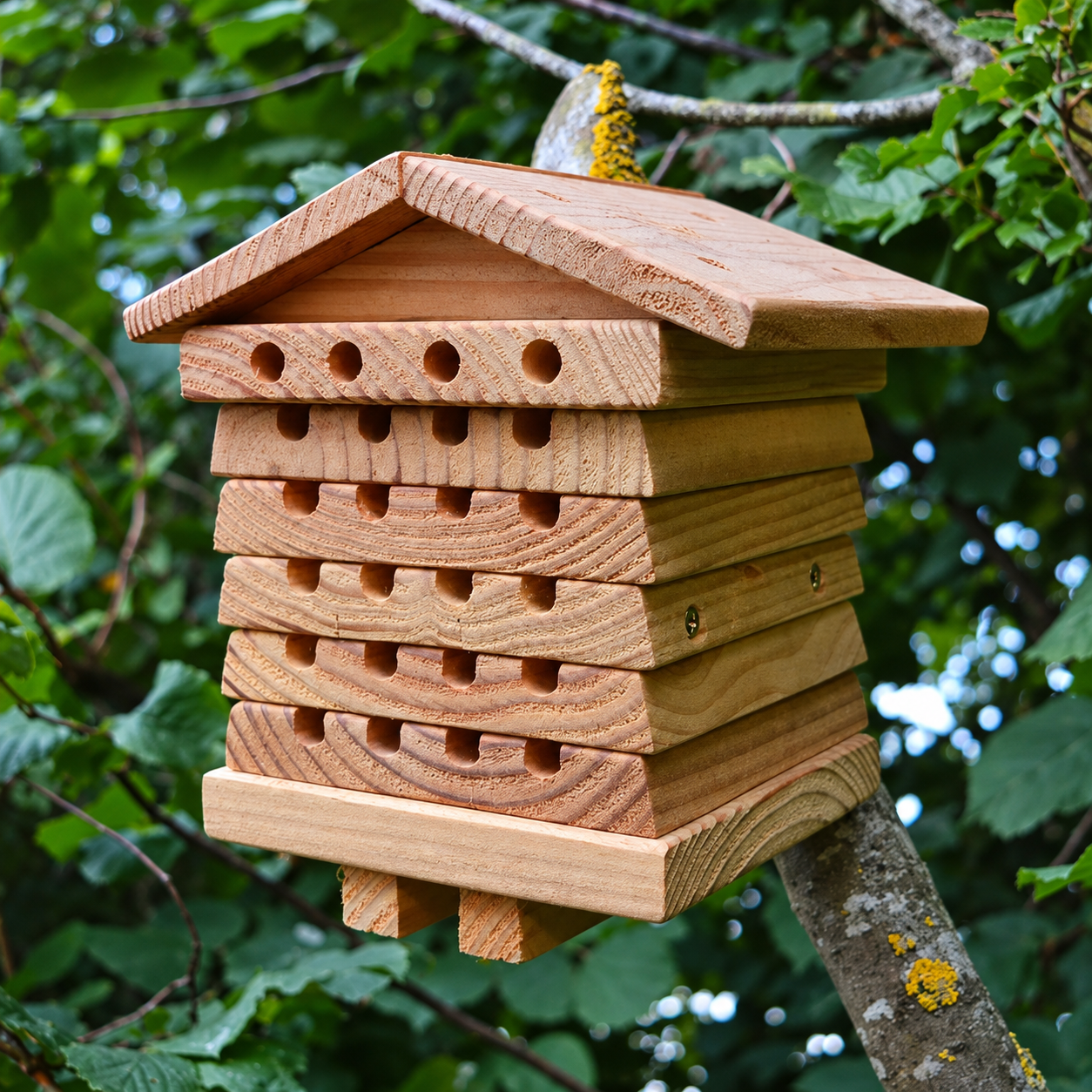
How a bee hotel actually works
Around nine in ten bee species are solitary. There is no hive, no queen and no honey. A female mates, finds a dry tunnel, and works alone: she flies out for pollen, packs it at the back of the tunnel, lays an egg on it, walls the cell off with mud or chewed leaf, and repeats until the tunnel is full. Then she caps the entrance and starts another.
Everything a bee hotel needs to do follows from that. The tunnel has to be the right width for her body. It has to be dry, because damp pollen grows mould and mould kills the brood. It has to be smooth, because she will squeeze in and out of it hundreds of times. And it has to be closed at the back, because parasitic wasps attack the larvae from behind.
The five-point buyer's checklist
1. A range of tunnel diameters, not one
Red mason bees want roughly 8mm. Leafcutter bees prefer 6–7mm. Small masked and yellow-faced bees need 3–4mm. A hotel drilled entirely at one width is only ever housing one species, and only if that species happens to be in your garden. Look for a spread from about 2mm to 10mm.
2. Untreated timber
Paint, stain and lacquer leave a solvent smell that inspecting females avoid, and they seal the wood so trapped moisture cannot escape. Untreated Western red cedar is the sensible choice: naturally rot-resistant, dimensionally stable, and thick enough at 19mm to buffer the temperature swings between a cold spring night and a hot afternoon.
3. A roof that overhangs, in a material that lasts
Rain landing on the nesting face is the single biggest cause of failed broods. A metal roof with an overhang on all sides throws water clear of the tunnel entrances. Copper does not rust or split the way thin plastic and felt do after one hard winter.
4. Hand-sanded tunnel interiors
Drilled bamboo and rough-milled holes leave splinters along the tunnel wall. Those splinters shred wings over a season of hundreds of entries. Push a fingertip into a tunnel: if you can feel any roughness, so can she.
5. A solid rear panel
Open-backed tubes and thin ply backs let parasitic wasps reach the developing larvae from behind. A solid back wall removes that route entirely.
What a good bee hotel does for your garden
Solitary bees are extraordinarily efficient pollinators — a single red mason bee does the pollination work of many honeybees, because she carries dry pollen loose on her abdomen and sheds it as she goes. Fruit trees, soft fruit, beans, tomatoes and squash all set better crops with them around. Putting up a well-made hotel is the fastest way to keep a resident population in the garden rather than passing through it.
The Wild Bee Hotel against that checklist
The Wild Bee Hotel was designed to the list above rather than to a price point: multiple tiers of hand-sanded tunnels from 2mm to 10mm, 19mm untreated Western red cedar walls, a hand-formed copper roof overhanging on every side, a solid rear panel, and a heavy-duty steel mount for a wall, fence or post. It costs £39.99 with free worldwide shipping, and if it does not convince you in the first 30 days you can send it back for a full refund.