Best bee hotel in the UK: an honest comparison by type, not by brand
Rather than ranking specific products, this page scores the four common types of bee hotel sold in the UK against the things that actually decide whether bees move in: bamboo bundles, drilled log sections, cardboard tube trays and cedar tunnel hotels. Judge whatever you are considering against the same table.
How to judge a bee hotel
The four common types sold in the UK
Bamboo bundles
A cluster of cut bamboo canes, often held in a wire ring or tin can. Cheap to produce and genuinely effective when prepared with care — cut just behind a node so the tunnel is sealed at the back, with the entrance rim sanded smooth. The type's weakness is quality control: mass-produced bundles are frequently sawn straight through nodes at both ends, which leaves an open corridor a female will inspect and reject.
Drilled log sections
A round or split log face drilled with a spread of tunnel diameters. Attractive and rustic-looking, and can perform very well if the drilling is graded and the interiors are finished smoothly. The risk with round, unseasoned logs is splitting as the wood dries and shrinks around the mounting point, which can crack tunnels open along their length after a season or two outdoors.
Cardboard tube trays
Removable paper or cardboard tubes packed into a frame, usually behind a clear or open front. The main advantage is hygiene — tubes can be pulled and replaced yearly, taking old cell debris and any parasite build-up with them. The trade-off is that cardboard offers less thermal buffering than thick timber, so brood inside can be more exposed to rapid temperature swings on a cold spring night.
Cedar tunnel hotels
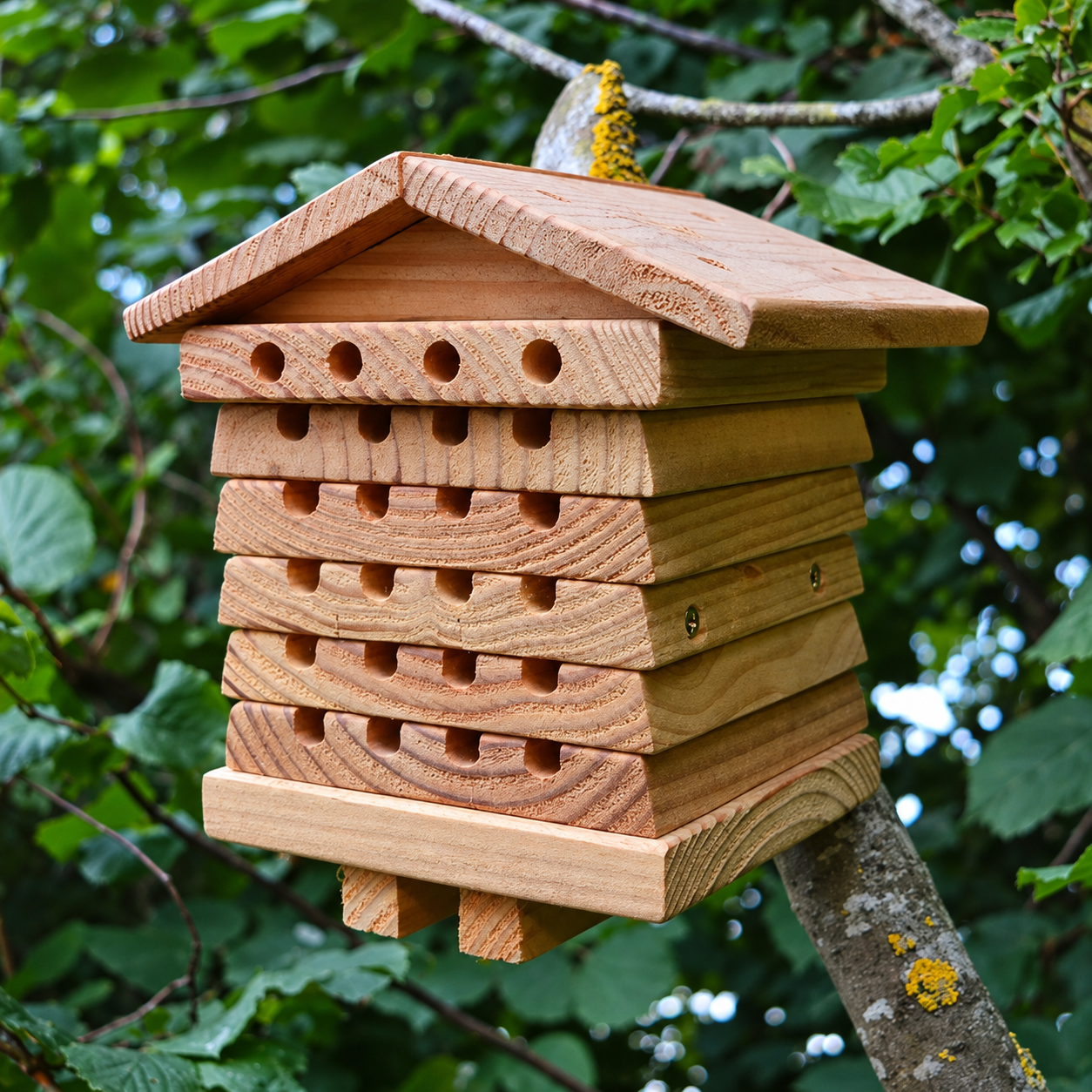
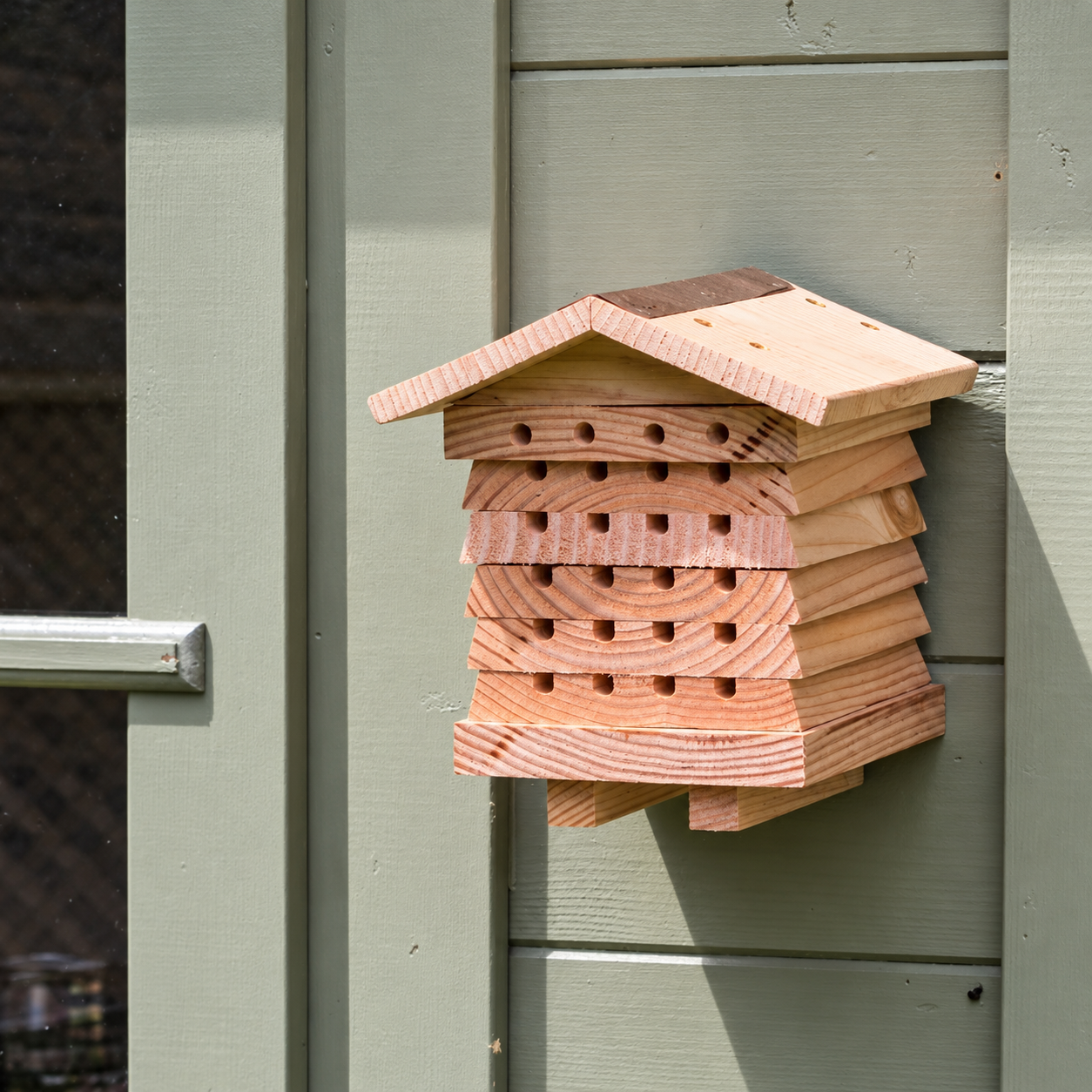
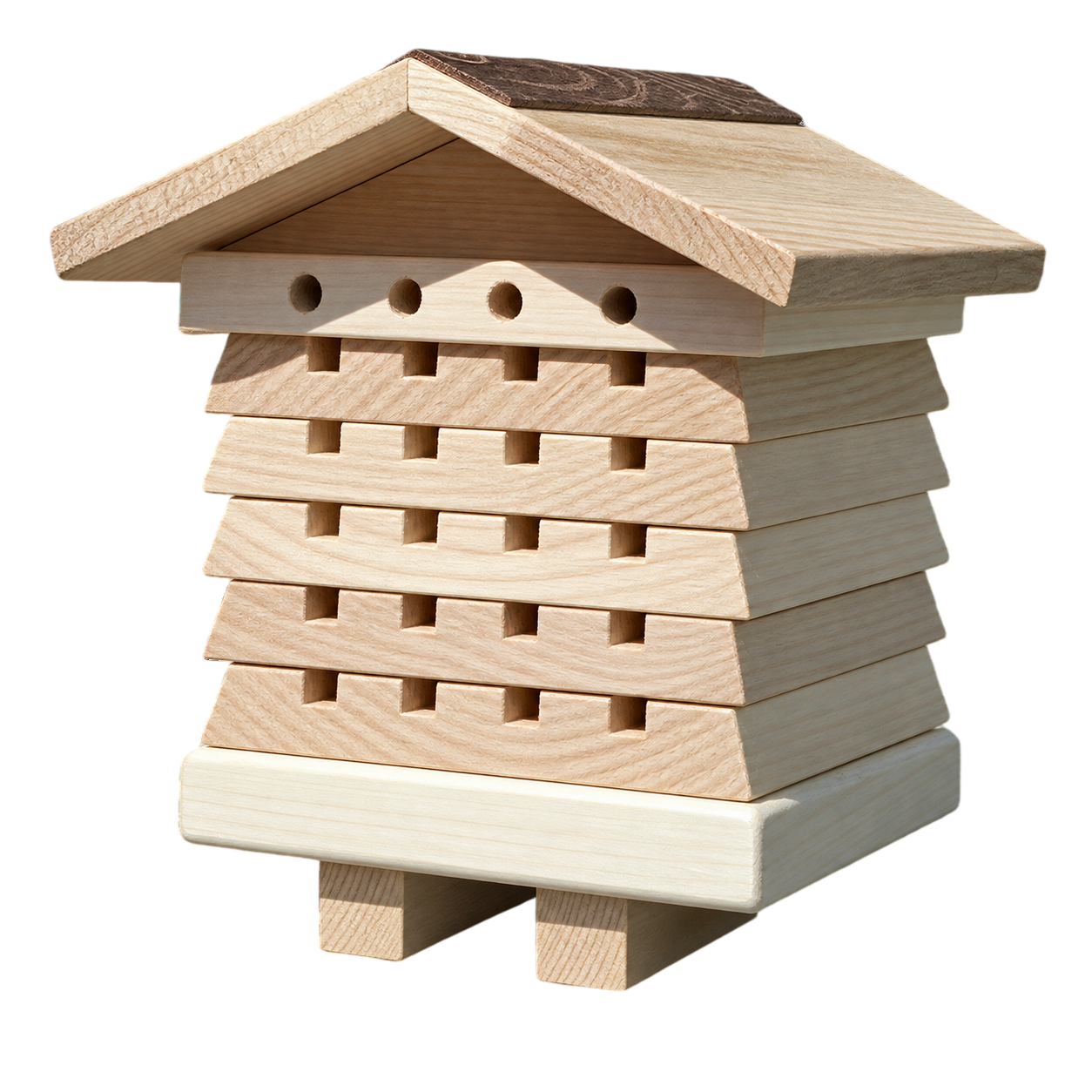
A solid timber body — typically cedar or oak — with tunnels bored directly into the wood, a solid rear panel, and usually a proper overhanging roof. The type generally scores highest on durability and thermal buffering because the timber itself does the insulating and rot resistance; the trade-off is a higher unit price than a bamboo bundle, reflecting the timber and finishing labour involved.
Scoring table: the fundamentals, not the brand
| Criterion | Bamboo bundle | Drilled log | Cardboard tray | Cedar tunnel hotel |
|---|---|---|---|---|
| Tunnel diameter range achievable | Moderate | Good | Good | Good |
| Typical durability outdoors | Moderate | Moderate (splitting risk) | Low (needs yearly renewal) | High |
| Thermal buffering | Moderate | Good | Lower | Good |
| Hygiene / renewability | Low unless rebuilt | Low | High | Moderate |
| Typical finish quality risk | High variability | Moderate variability | Low variability | Low variability at the top of the range |
None of these scores is fixed — a carefully prepared bamboo bundle can outperform a poorly finished cedar box. The table describes typical outcomes across the market, which is why the individual checks below matter more than the type label on its own.
Six checks to apply to any type
- A spread of tunnel diameters, roughly 2mm to 10mm, not one size throughout.
- Untreated timber or genuinely clean-cut bamboo, never painted or varnished.
- A roof or cover that projects beyond the tunnel face, ideally metal.
- A solid back or a tunnel stopped short, never open at both ends.
- Smooth tunnel interiors — run a fingertip in; it should not catch.
- A rigid mount to a fixed surface, not a loose wire loop that lets it swing.
These are the same six checks used throughout our bee hotel buyer's checklist, and they apply whichever type you end up choosing.
Common mistakes when comparing options
- Judging by photograph rather than checking tunnel finish and roof overhang.
- Assuming a higher compartment count means more species will use it.
- Buying the cheapest bamboo bundle without checking how the canes were cut.
- Overlooking mount quality, which decides whether the hotel stays still enough to be used.
Season by season, whichever type you choose
Red mason bees (Osmia bicornis) fly and inspect tunnels from March to June; leafcutter bees (Megachile species) follow from June to August. Leave whichever type you buy undisturbed and in place through autumn and winter, since the next generation develops inside the sealed tunnels regardless of what the hotel is made from.
Where the cedar tunnel type, and the Wild Bee Hotel specifically, sits
The Wild Bee Hotel is a cedar tunnel hotel built to the top of that category's range: untreated Western red cedar 19mm thick, a hand-formed copper roof overhanging on every side, tiers of hand-sanded tunnels from 2mm to 10mm, a solid rear panel and a heavy-duty steel mount. £39.99 for one, multi-packs from £49.99, free worldwide shipping and a 30-day money-back guarantee if it does not score well against your own checks once it arrives.
Questions people ask next
What type of bee hotel is best for a small garden?
Are bamboo bee hotels worse than wooden ones?
Do cardboard tube trays need replacing every year?
Is a more expensive bee hotel always the better choice?
How many bee hotels should I put up?
What should I check on delivery, whatever type I buy?
Where the cedar tunnel type scores highest
A graded spread of tunnels, a solid rear panel and a genuinely weatherproof roof — the fundamentals this comparison scores against, built in as standard.
About Clayton Dawson
Cabinetmaker and solitary-bee keeper, and the maker of the Wild Bee Hotel. Clayton has kept red mason and leafcutter bees in his own garden for years, and every guide on this site is written and checked against what he sees in the tunnels each season rather than copied from a catalogue. Read the full story.
First published 2 July 2025 · last reviewed 5 September 2026.
What we based this on: RHS, Bumblebee Conservation Trust, Buglife.