Insect hotels in the UK: which type to buy
At a glance
- Four types on sale: cane bundles, mixed bug boxes, habitat towers, timber nest blocks.
- Only solid timber nest blocks reliably suit nesting bees.
- UK rainfall makes roof overhang and timber thickness the decisive features.
- Price is a poor guide; decoration is often what the extra money buys.
- Everything stays outdoors all year, fixed firmly, sheltered from driving rain.
The four types you will find
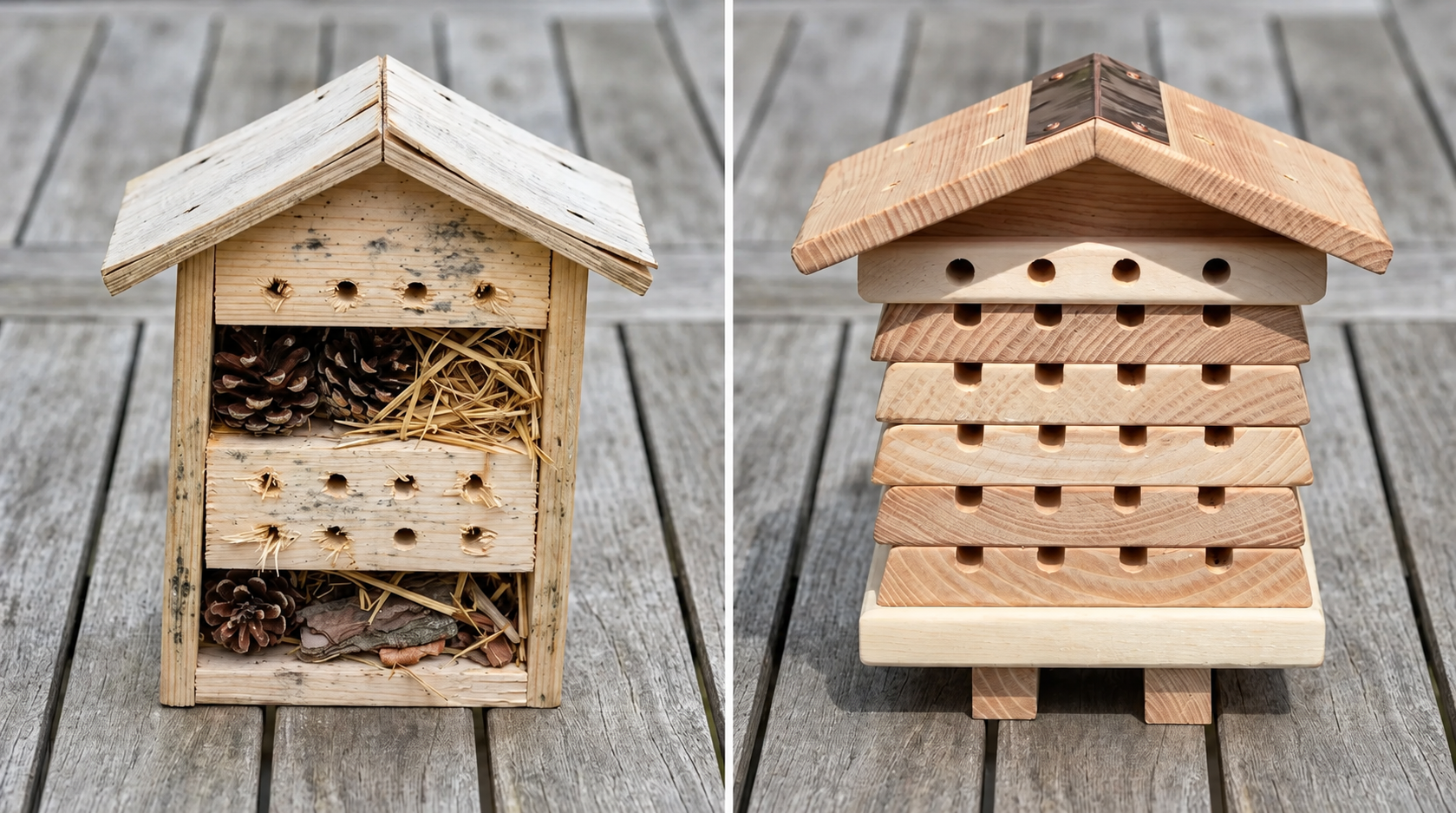
| Type | Typical build | Actually houses | UK weather verdict |
|---|---|---|---|
| Cane bundle | Short bamboo in a thin frame or tin | Little; often nothing at all | Poor — open ends wick water, canes split |
| Mixed bug box | Plywood compartments, cones, slats, straw | Ladybirds, lacewings, beetles, spiders | Fair in shelter; swells if exposed |
| Habitat tower | Large stacked pallet-style structure | Broad invertebrate life, ground level | Good as habitat; damp by design at the base |
| Timber nest block | Thick untreated wood, drilled tunnels, real roof | Solitary bees, solitary wasps | Good — the type that survives and gets used |
There is a place for more than one of these in a garden: a habitat tower or bug hotel low down for beetles and overwintering insects, and a nest block high up in morning sun for bees. What does not work is expecting one box in one position to serve both, because the requirements are opposites.
Why the British climate decides this
UK gardens combine mild, wet winters with long spells of driving rain — the worst possible conditions for the inside of a nesting tunnel. Water that reaches a cell spoils the pollen store the larva depends on and encourages mould, so a brood can be lost without a single predator involved. That is why a roof that projects beyond the tunnel faces matters more than the prettiness of the box, and why timber thickness matters more than the number of compartments. The durability guide goes through how each material fails.
What to check in a shop or listing
- Timber at least 15mm thick, untreated, not plywood or MDF.
- Tunnels 10–15cm deep — a listing that quotes widths but no depth is hiding something.
- A range of widths, roughly 2mm to 10mm, rather than a single bit size.
- Smooth tunnel mouths; run a fingertip round the rim if you can.
- A solid back you cannot see light through.
- A roof that overhangs the front, ideally metal or slate, and pitched.
- A fixing arrangement for a wall, not a hanging cord.
Widths and depths are covered species by species in the hole-size guide, which is the fastest way to tell a serious product from a decorative one.
Prices in the UK, and what they buy
Cane bundles and small bug boxes typically sell for single figures to the mid teens, mixed boxes and towers for twenty to fifty pounds depending on size, and well-made timber nest blocks from around thirty pounds upwards. Within each band, quality varies widely, and paying more often buys printing, paint or a novelty shape rather than depth and dryness. The honest way to compare is cost per season of use: a box that is never occupied and splits in three winters is more expensive than one that works for a decade. The bee box page works through that arithmetic.
Siting, wherever you buy
Bee nest blocks: chest height, tunnels facing between south-east and south, fixed rigidly to a wall, fence post or shed, sheltered from driving rain, clear flight space in front. Bug boxes and towers: lower down, in shelter, near dense planting. Neither should swing, and neither should come indoors in winter. The detail is in where to put a bee hotel.
Our own
The Wild Bee Hotel is the fourth type on the table: 19mm untreated Western red cedar, a hand-formed copper roof that overhangs the tunnel faces, hand-sanded tunnels from 2mm to 10mm dead-ended against a solid rear panel, made to be fixed rather than hung. It is £39.99 for one, with free worldwide shipping and 30 days to change your mind — and if a broad habitat box is what your garden needs instead, buy that. They are not competing for the same corner.
Questions people ask next
Which insect hotel is best for UK gardens?
Why do cheap insect hotels fall apart so quickly?
Are insect hotels available in the UK the same as bee hotels?
Where can I buy a good one in the UK?
Do UK insect hotels need to come indoors in winter?
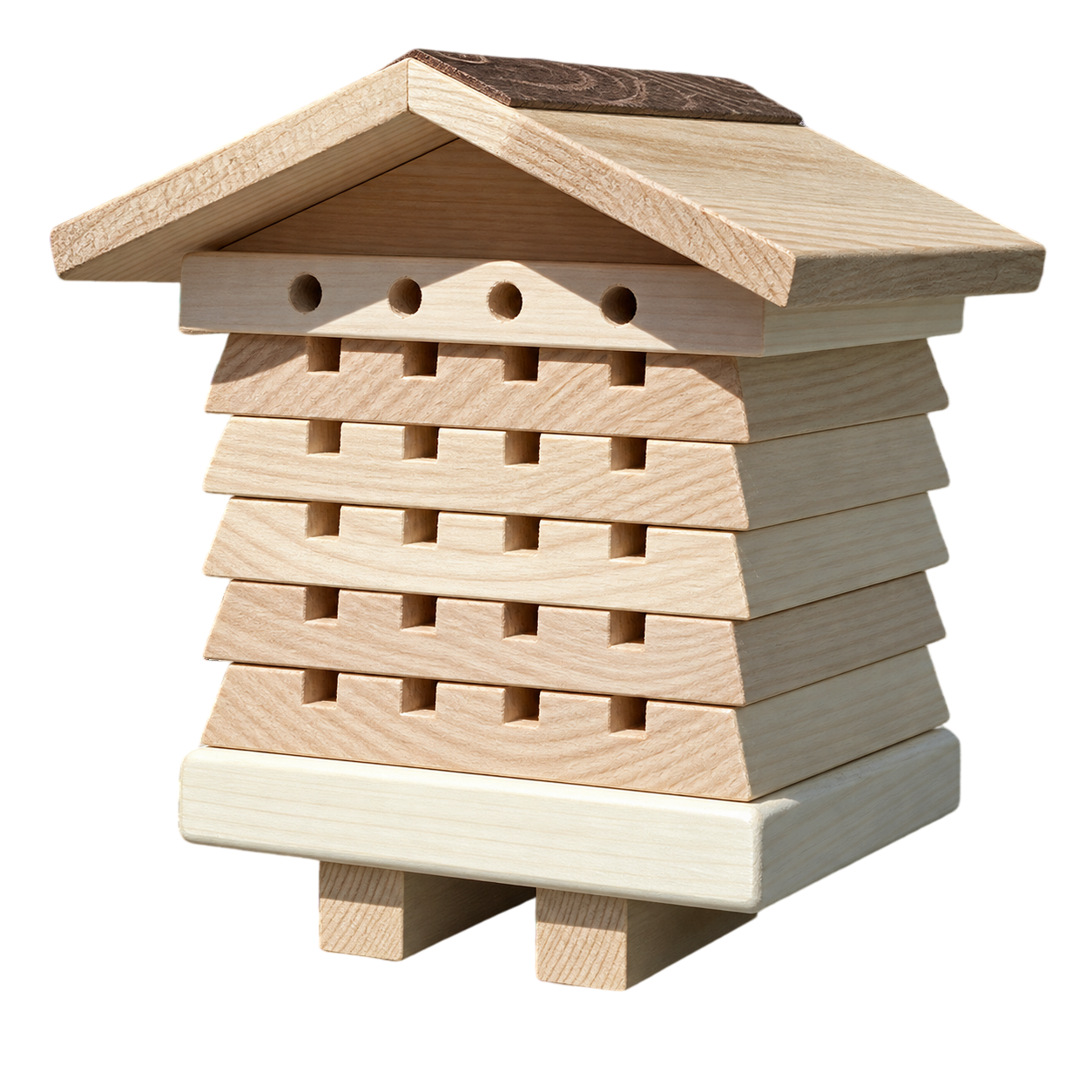
The type that houses bees
A solid cedar nest block with deep, dry, hand-sanded tunnels from 2mm to 10mm and a sealed back.
About Clayton Dawson
Cabinetmaker and solitary-bee keeper, and the maker of the Wild Bee Hotel. Clayton has kept red mason and leafcutter bees in his own garden for years, and every guide on this site is written and checked against what he sees in the tunnels each season rather than copied from a catalogue. Read the full story.
First published 18 June 2025 · last reviewed 20 September 2026.
What we based this on: RHS, Buglife, Wildlife Trusts.