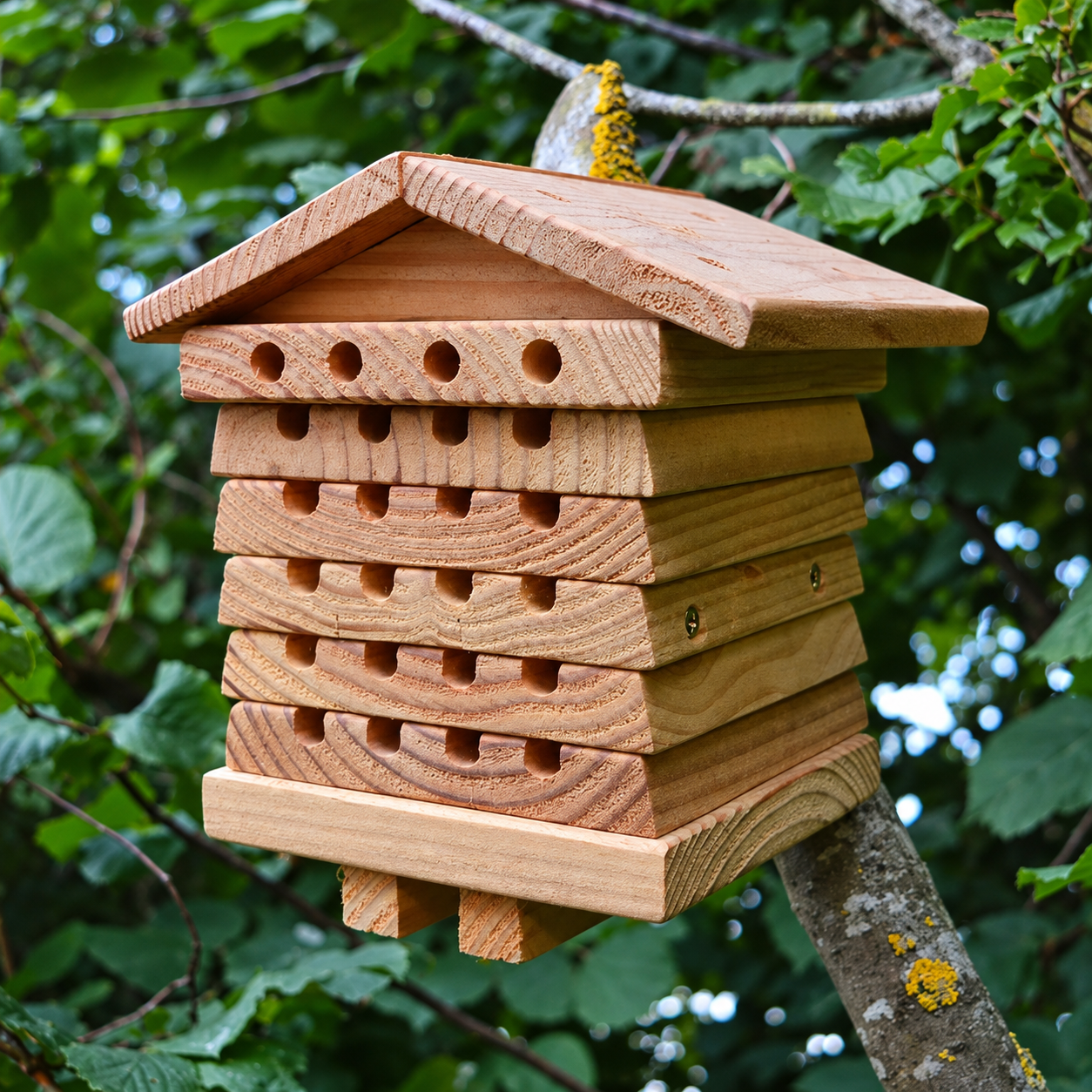
Wooden bee house for the UK: which timber actually survives our weather?
UK weather — persistent damp, freeze-thaw winters and long grey spells with little drying sun — is hard on outdoor timber. Untreated Western red cedar resists rot naturally without chemical treatment, while pine, treated softwood and bamboo each carry their own trade-offs worth knowing before you buy.
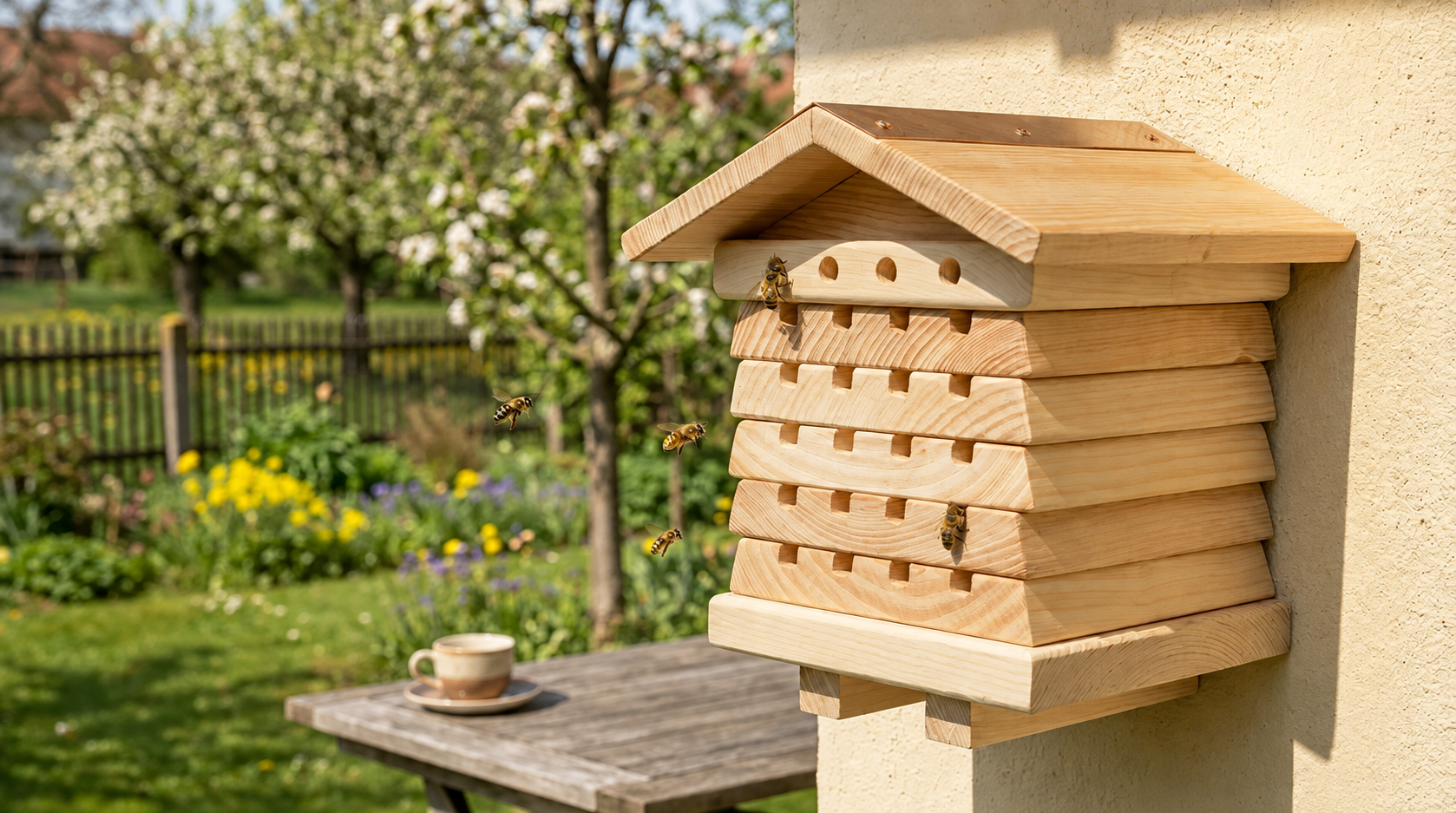
At a glance: timber choice for UK bee houses
- UK weather means persistent damp exposure, not just occasional rain.
- Untreated Western red cedar resists rot naturally, without chemical coatings.
- Pine is cheaper but decays faster untreated, or needs treatment that sits close to nesting bees.
- Bamboo works only if cleanly cut, sealed behind a node, and sanded — and it's shorter-lived than solid cedar.
A bee hotel in a UK garden spends most of its life outdoors through exactly the conditions that rot timber fastest — mild, damp winters with little drying sun, rather than hard freezes that at least dry the wood out between storms. The timber choice behind the product matters as much as tunnel size, and it's rarely explained clearly at the point of sale.
Why untreated Western red cedar holds up
Western red cedar contains natural oils called thujaplicins that resist fungal decay and deter wood-boring insects, which is why it's the standard untreated choice for outdoor cladding, shingles and garden structures across the UK. Left untreated, it weathers to a silvery grey but keeps its structural integrity for years, and — critically for a bee house — it never needs a chemical preservative that would otherwise sit within centimetres of developing bee larvae.
Pine: cheaper, but a different lifespan
Pine is a common, inexpensive choice for budget bee houses, but it has little natural resistance to rot. Left untreated outdoors in UK conditions, it can start softening and darkening with fungal growth within a couple of seasons. Manufacturers usually respond by treating it with preservative — which solves the rot problem but reintroduces the concern about chemicals sitting close to nesting tunnels.
Treated timber: the trade-off explained
Pressure-treated softwood lasts considerably longer outdoors than untreated pine, and for garden structures generally that's a reasonable trade-off. For a bee house specifically, though, the tunnels themselves are usually drilled directly into or lined within that same treated timber, put the treatment chemical directly adjacent to where a female provisions and seals her brood cells for months at a time. It's not a proven hazard, but it's an avoidable one when naturally durable species exist.
Bamboo: workable, with caveats
Hollow bamboo canes are a traditional, low-cost tunnel material and can work well provided each cane is cut immediately behind a natural node — so the tunnel is sealed at the back — and the cut end is sanded so it doesn't shred wings on entry. Bamboo's weakness in the UK is that it dries, shrinks and can split over a season or two of damp-dry cycling, and loose bamboo bundles are more prone to shifting or working loose in wind than a solid timber block. See our tunnel size guide for why a clean, sealed cut matters regardless of material.
| Material | Rot resistance untreated | Chemical exposure risk | Typical outdoor lifespan |
|---|---|---|---|
| Untreated Western red cedar | High — natural oils resist decay | None | Many years, weathering to grey |
| Untreated pine | Low | None, but shorter-lived | One to a few seasons before visible decay |
| Treated softwood | Improved by treatment | Chemical sits near tunnels | Several years, treatment-dependent |
| Bamboo (cleanly cut) | Moderate, but splits with damp cycling | None | A season or two before replacement needed |
Common mistakes buyers make
- Choosing on price without checking whether the timber is treated or untreated.
- Assuming any hardwood is durable outdoors — durability varies hugely by species, not just hardwood vs softwood.
- Buying loose bamboo bundles with no back panel, which lets damp and parasites in from behind.
- Ignoring the roof — even the best timber decays faster if rain sits on end grain repeatedly.
Season by season: what UK weather does to timber
Spring and summer showers are manageable for any reasonable timber with a good roof overhang. It's the long, low-intensity damp of a UK autumn and winter — condensation, short days, little drying wind — that punishes poorly chosen timber over successive years, which is also exactly when overwintering brood inside the tunnels (see how a bee house works) most needs a dry, sound structure around it.
What to look for when buying
- Confirmation of species — "cedar" alone can mean several timbers of very different durability.
- Confirmation the timber is untreated, if chemical exposure near tunnels concerns you.
- A roof that genuinely overhangs the tunnel face, in a weatherproof material.
- Sealed rear panels regardless of timber choice.
- Solid single-block construction over loose bundled canes, for wind resistance.
Questions people ask next
Is untreated wood actually safe to leave outside all year in the UK?
Why not just treat pine with a wood preservative instead?
Is bamboo a good budget alternative to a wooden bee house?
How long does an untreated cedar bee house last outdoors in the UK?
Does the roof material matter as much as the timber?
Can I oil or varnish a wooden bee house to make it last longer?
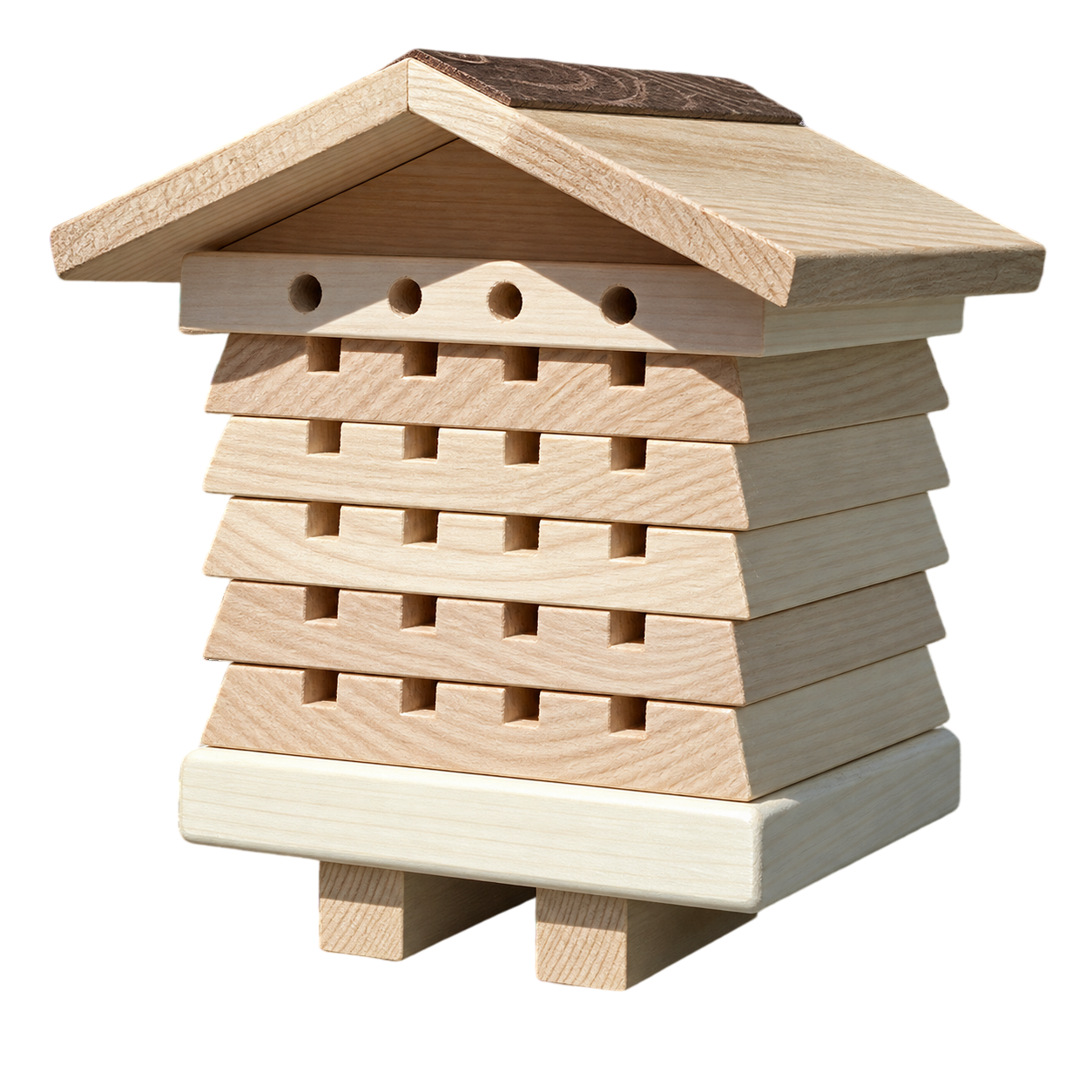
Timber that doesn't need chemical treatment
The Wild Bee Hotel is built from 19mm untreated Western red cedar, which is naturally rot-resistant without any coating that could sit close to nesting bees. £39.99, free worldwide shipping, 30-day money-back guarantee.
About Clayton Dawson
Cabinetmaker and solitary-bee keeper, and the maker of the Wild Bee Hotel. Clayton has kept red mason and leafcutter bees in his own garden for years, and every guide on this site is written and checked against what he sees in the tunnels each season rather than copied from a catalogue. Read the full story.
First published 3 September 2025 · last reviewed 11 August 2026.
What we based this on: RHS, Wildlife Trusts.