How does a bee house work, from first visit to next spring's bees?
At a glance: the full cycle
- Spring: a mated female inspects and chooses a dry, sheltered tunnel.
- Provisioning: repeated trips bring back pollen and nectar into a paste.
- Laying: one egg per cell, laid on top of the provision.
- Partitioning: a mud or leaf wall seals each cell before the next is built.
- Capping: a thicker plug seals the whole tunnel once it's full.
- Development: egg to larva to pupa to adult across summer and autumn.
- Overwintering: fully formed adults wait, dormant, inside the sealed tunnel.
- Emergence: next spring, males first, then females, chew or push their way out.
Almost everyone who buys a bee hotel pictures the end result — bees flying in and out on a sunny afternoon — without knowing quite what is happening inside the wood for the eleven months either side of that. It's worth walking through, because most of the specification decisions that matter (tunnel depth, diameter, roof, rear panel) only make sense once you understand the cycle they are protecting.
Step one: she finds and inspects a tunnel
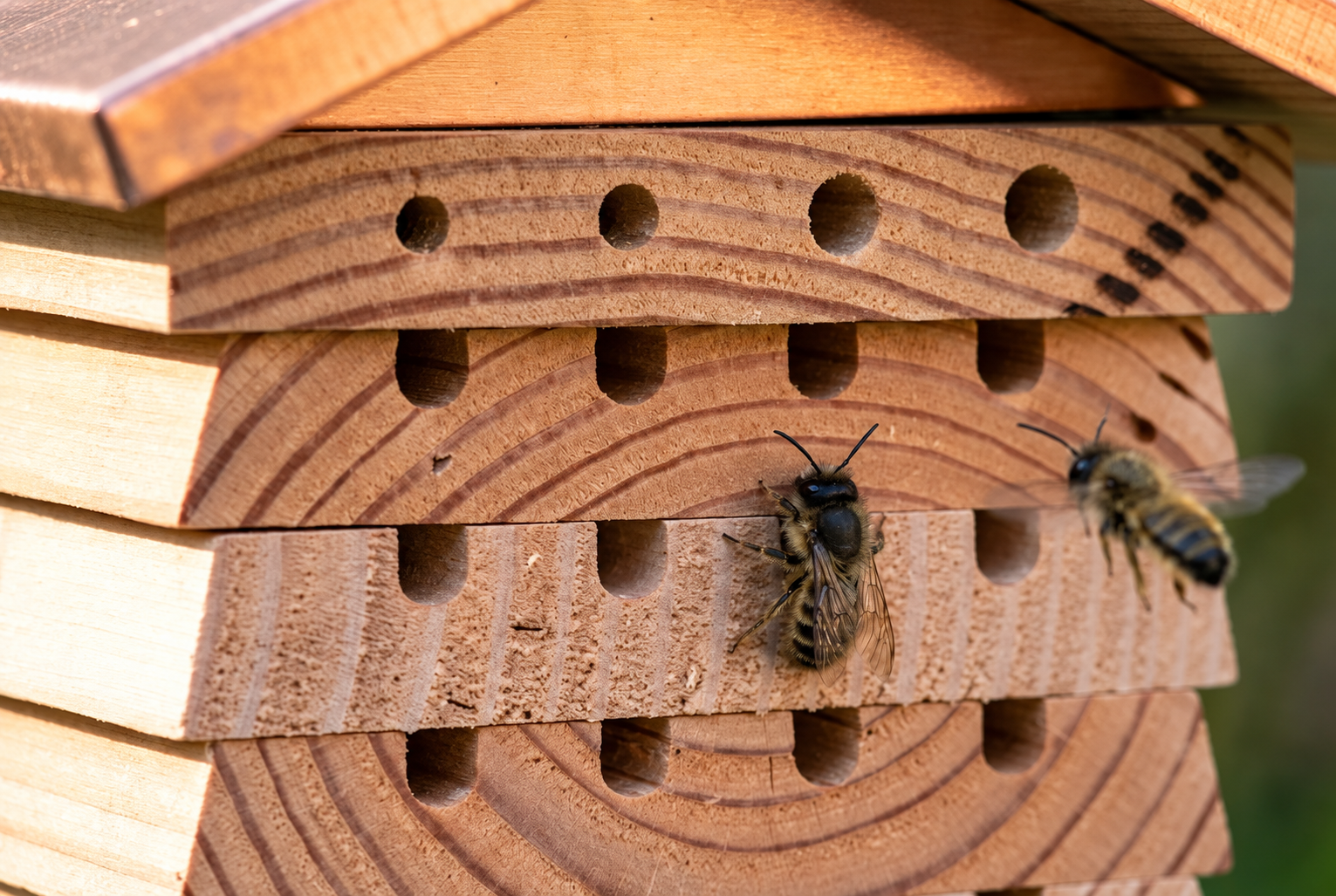
A mated female red mason bee (Osmia bicornis, on the wing March to June) or leafcutter (Megachile, June to August) searches for a cavity of roughly the right diameter — 8mm suits mason bees, 6–7mm suits leafcutters — that is dry, sheltered from direct rain, and sealed at the back. She will investigate several tunnels before committing, often returning to the same block over consecutive days. A through-hole, a damp tunnel, or one facing straight into prevailing wind and rain gets rejected, which is one reason so many decorative bee houses sit empty.
Step two: provisioning — the bulk of her working life
Once she has chosen a tunnel, she spends the following one to three weeks making dozens of return flights, each one collecting pollen and nectar and packing it into a paste at the back of the tunnel. This is the most vulnerable part of the whole cycle for her: she is flying, unguarded, in all weather windows she can find, and a single wasted afternoon lost to rain or cold slows the whole nest.
Key fact
Step three: laying and partitioning, cell by cell
Once enough provision sits at the back of the tunnel, she lays a single egg on top of it, then builds a partition — mud for mason bees, neatly cut leaf discs for leafcutters — and starts the next cell in front of it. She works from the back of the tunnel forward, which is why depth matters: a 10–15cm tunnel gives room for six or more cells, while a shallow 5cm tunnel might fit only two or three.
She also chooses the sex of each egg. Fertilised eggs become females and are laid at the back of the tunnel; unfertilised eggs become males and are laid nearer the entrance. This is deliberate: males emerge first the following spring and are ready and waiting when the females, laid deeper and taking slightly longer, emerge after them. See our guide on tunnel diameter and depth for the numbers behind this.
Step four: capping the tunnel
When the tunnel is full — or when she runs out of season — she builds a final, thicker plug at the entrance. This cap is often visibly different from the internal partitions, and it's the clearest outward sign that a tunnel is occupied. A capped mud plug means mason bees; a capped, tightly rolled leaf disc plug means leafcutters.
| Stage | Typical timing | What's visible from outside |
|---|---|---|
| Tunnel selection | Spring, over days | Bee investigating, entering and leaving repeatedly |
| Provisioning & laying | 1–3 weeks per tunnel | Regular return flights, pollen visible on her body |
| Capping | Once the tunnel is full | A visible mud or leaf-disc plug at the entrance |
| Development | Summer–autumn | Nothing — the tunnel stays sealed |
| Overwintering | Autumn–winter | Nothing — adults dormant inside cocoons |
| Emergence | Following spring | Males first, chewing through the cap; females days later |
Step five: development through the summer
Inside each sealed cell, the egg hatches into a larva that eats the provision left for it, then spins a cocoon and pupates. By late summer or autumn it has usually completed metamorphosis into a fully formed adult — but it does not emerge yet. It waits, dormant, inside the cocoon and the sealed tunnel through the whole of winter.
Step six: overwintering — the part that goes wrong
This is the stage most bee houses fail at, because it's the longest and least visible. A damp tunnel that was fine in summer can grow mould over a wet winter and kill the brood outright. A through-hole lets cold draughts and parasitic wasps reach cells that a sealed rear panel would have protected. This is exactly why the construction details in our bee hotel basics guide — sealed backs, roof overhang, no gaps — matter far more in December than they do in June.
Step seven: emergence — the cycle completing
As temperatures rise the following spring, males emerge first, chewing or pushing through the cap nearest the entrance. Females follow within a week or two. They mate almost immediately, and the females then disperse to find their own tunnels — quite possibly the same block, quite possibly a neighbour's — and the entire cycle begins again.
What to look for if you want this cycle to succeed
- Tunnels 10–15cm deep, so a female can lay a full mix of sons and daughters.
- A solid rear panel — never a through-hole.
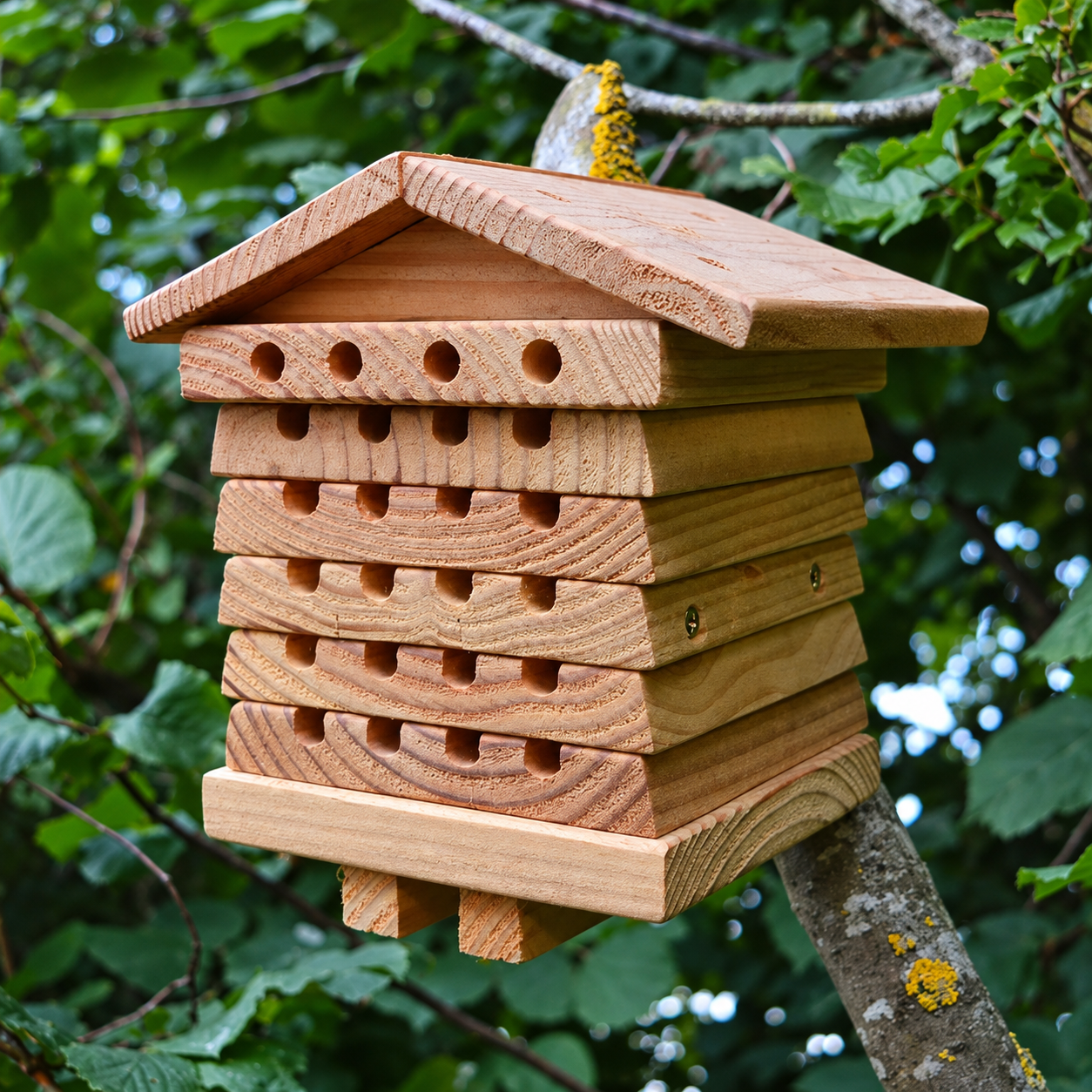
- A roof that genuinely overhangs the tunnel face, not just a flat lid.
- Smooth, sanded tunnel interiors so wings aren't shredded on repeated trips.
- A site facing south to south-east, fixed firmly so wind doesn't rock it while she's laying.
Read our siting guide for the practical detail on getting that placement right before the season starts.
Questions people ask next
How long does it take from egg to adult bee?
Do the same tunnels get reused every year?
Why do some tunnels stay sealed with no bee coming out?
Can I watch the female working without disturbing her?
What happens if it rains while she is building a nest?
Do males and females emerge at the same time?
Give the cycle somewhere dry to happen
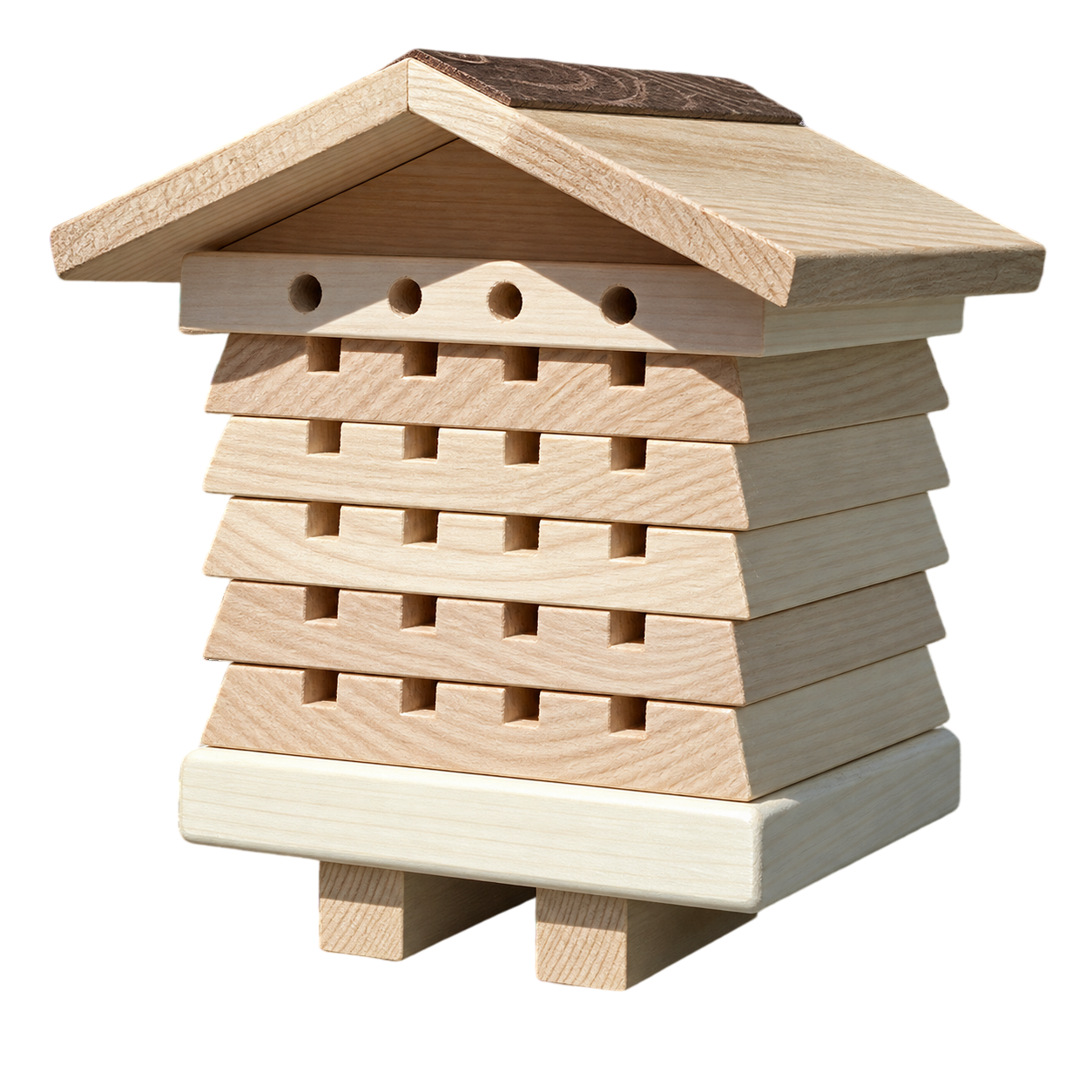
The Wild Bee Hotel is built to the depths and diameters this cycle needs, with a copper roof keeping the entrances dry through the winter the brood spends inside. £39.99, free worldwide shipping, 30-day money-back guarantee.
About Clayton Dawson
Cabinetmaker and solitary-bee keeper, and the maker of the Wild Bee Hotel. Clayton has kept red mason and leafcutter bees in his own garden for years, and every guide on this site is written and checked against what he sees in the tunnels each season rather than copied from a catalogue. Read the full story.
First published 8 April 2025 · last reviewed 19 May 2026.
What we based this on: Bumblebee Conservation Trust, RHS, Buglife.