Mason bees in the UK: identification, season and how to help them
At a glance
- Species: red mason bee, Osmia bicornis — the UK's commonest garden mason bee.
- Season: active March to June, peaking in April and May.
- Nest material: chewed, damp mud or clay, not wax or wood pulp.
- Behaviour: solitary, non-aggressive, no hive, no honey, no queen.
- Value: efficient pollinators of early fruit blossom — apples, pears, plums and cherries.
How to identify a red mason bee
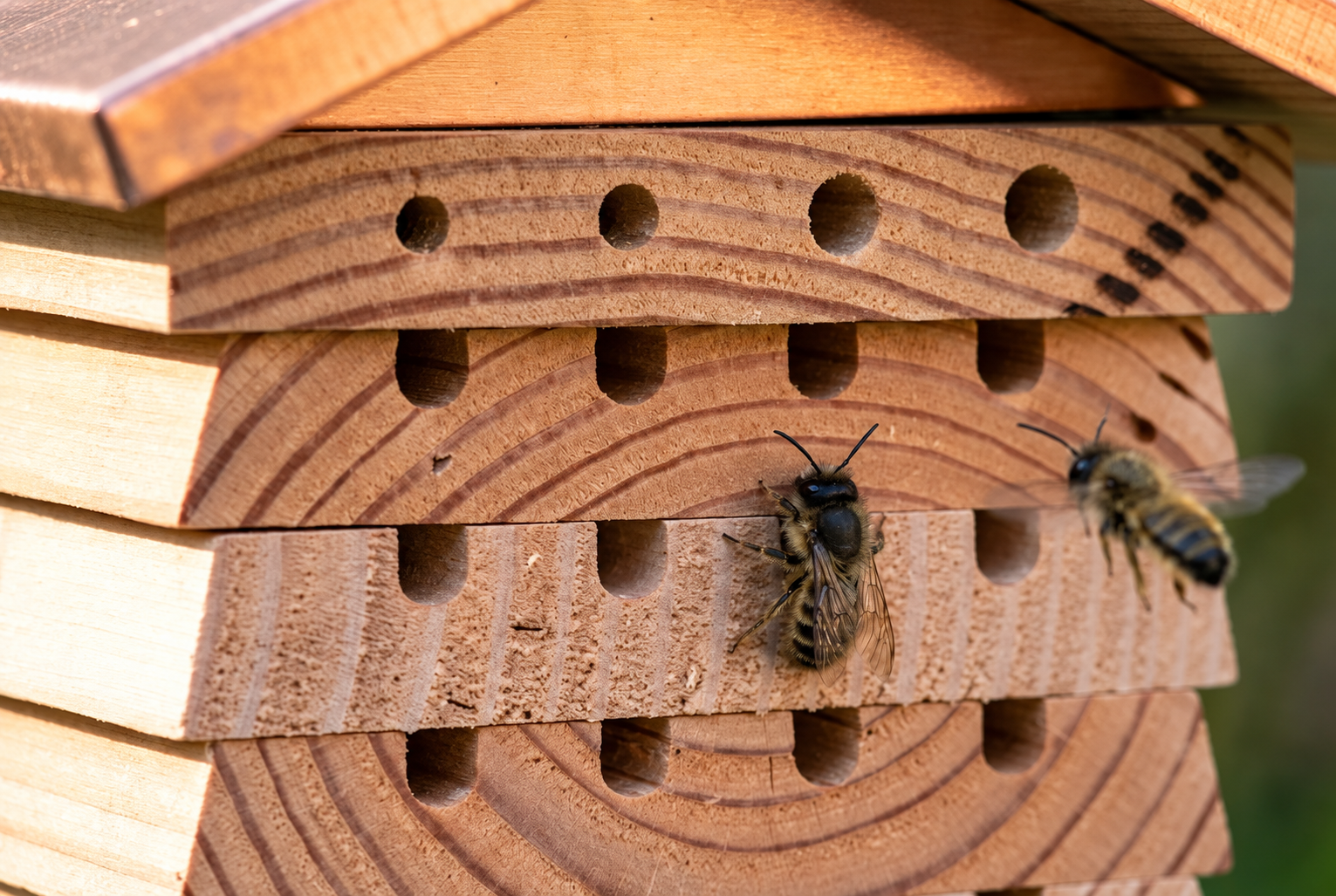
Red mason bees are noticeably furrier and stockier than honeybees, with a dense covering of ginger-orange hair across the thorax that fades slightly on the abdomen as the season wears on and the fur rubs thin. Males emerge first, usually a week or two before females, and are smaller with a distinctive tuft of pale hair on the face; females are larger, darker-furred, and carry two small horn-like projections on the front of the head that they use to shape mud — the "bicornis" in the scientific name. If you see a bee carrying a pale dust of pollen on the underside of its abdomen rather than on its legs, that's a strong sign it's a mason bee rather than a honeybee or bumblebee.
The March–June flight season
Red mason bees have one generation a year and a short adult flying season, typically running from March through to June, with the exact start shifting a little from year to year and region to region depending on spring temperatures. Males emerge first from overwintered cocoons and wait near nest sites for females to appear; once mated, males' role is largely over and they die within a few weeks, while females spend the following six to eight weeks provisioning nest cells. By midsummer the adults have died off entirely, leaving next year's bees developing quietly inside sealed cells until the following spring.
How mud cell-building actually works
A female mason bee finds a hollow tunnel — a hollow plant stem, an old beetle bore-hole, or the tunnels in a bee hotel — and works from the back forward. She provisions a mass of pollen and nectar, lays a single egg on top of it, then seals that cell with a wall of mud she carries in her mandibles from a nearby damp patch of soil or clay. She repeats this many times down the length of the tunnel, laying female eggs in the cells furthest from the entrance and male eggs in the cells nearer the front, before capping the whole tunnel with a thicker mud plug. That female-at-the-back, male-at-the-front pattern is exactly why tunnel depth matters if you want a hotel to raise more females as well as males — our guide to hole sizes and depth covers the numbers in detail.
Pollination value: why gardeners and orchard keepers rate them
| Trait | Why it matters for pollination |
|---|---|
| Flies in cool, overcast weather | Active on days too cold or dull for honeybees, extending the pollination window |
| Belly-carried pollen ("scopa") | Loosely held pollen brushes off onto flowers far more readily than a honeybee's packed leg baskets |
| Visits many flowers per trip | Higher flower-visit rate per bee than honeybees in cool spring conditions |
| Season overlaps fruit blossom | Active exactly when apple, pear, plum and cherry trees are flowering |
Orchard growers have long valued red mason bees because their flight season lines up almost perfectly with apple and plum blossom, and because a single female mason bee is estimated to be a considerably more efficient pollinator, flower for flower, than a single honeybee in cool spring weather. A garden or allotment with even a modest population can see a real difference in fruit set on early-flowering trees.
Mason bees vs. "masonry bees" and "mortar bees" in walls
Homeowners sometimes spot bees or bee-like insects investigating gaps in old brick or stone walls and assume their house is under attack from "mortar bees." In most cases these are solitary bees or wasps taking advantage of existing weep holes, soft old mortar joints, or crumbling pointing — using a gap that's already there rather than excavating sound brick. True wall-nesting species do exist and can slowly enlarge very soft, degraded lime mortar over years, but they are a distinct issue from garden mason bees using a bee hotel, and repointing with a modern hard mortar is the usual long-term fix if it's a genuine concern. It's worth not confusing the two: a mason bee investigating your fence-mounted bee hotel is doing exactly what you want, while a bee investigating a crumbling wall joint is a separate, structural question.
Common mistakes gardeners make with mason bees
- Offering only one tunnel diameter — 8mm suits red mason bees, but a spread of sizes supports more species overall.
- Choosing a site with no nearby mud or damp soil, which leaves females with nowhere to gather nesting material.
- Moving an occupied hotel mid-season, which disorients returning females.
- Bringing sealed tunnels indoors over winter — the cold is part of their development, not a threat to it.
- Spraying nearby blossom with insecticide during the March–June flight window.
How to support mason bees in a UK garden
Plant or tolerate early-flowering species — fruit blossom, lungwort, flowering currant, and early spring bulbs — so there's forage available as soon as bees emerge in March. Leave a patch of bare, damp, clay-rich soil accessible somewhere in the garden; without it, females have nowhere nearby to collect mud, however good the nest site itself is. Then provide the nest site: a hotel with 8mm tunnels roughly 10–15cm deep, sited south or south-east facing and sheltered from driving rain, is the single most effective thing most gardens are missing. For the full specification of what makes a nest site work well, our mason bee house guide goes through the detail, and the buyer's checklist covers what to look for if you're choosing one.
What to look for if you're buying a nest site for mason bees
- 8mm tunnels among the sizes offered, since that's the diameter red mason bees use.
- Tunnels 10–15cm deep, sealed at the back rather than open right through.
- Smooth, splinter-free tunnel interiors that won't damage wings over repeated use.
- A roof or overhang that keeps rain off the entrances, since damp mud plugs can fail.
- A stable, firmly fixed mount — a swinging hotel confuses returning females.
Questions people ask next
Are mason bees dangerous or aggressive?
What's the difference between mason bees and 'mortar bees' in a wall?
When will I see mason bees in my garden?
How do I tell a red mason bee from a honeybee?
Do mason bees make honey?
What plants are best for supporting mason bees?
Once you've spotted them, give them a tunnel
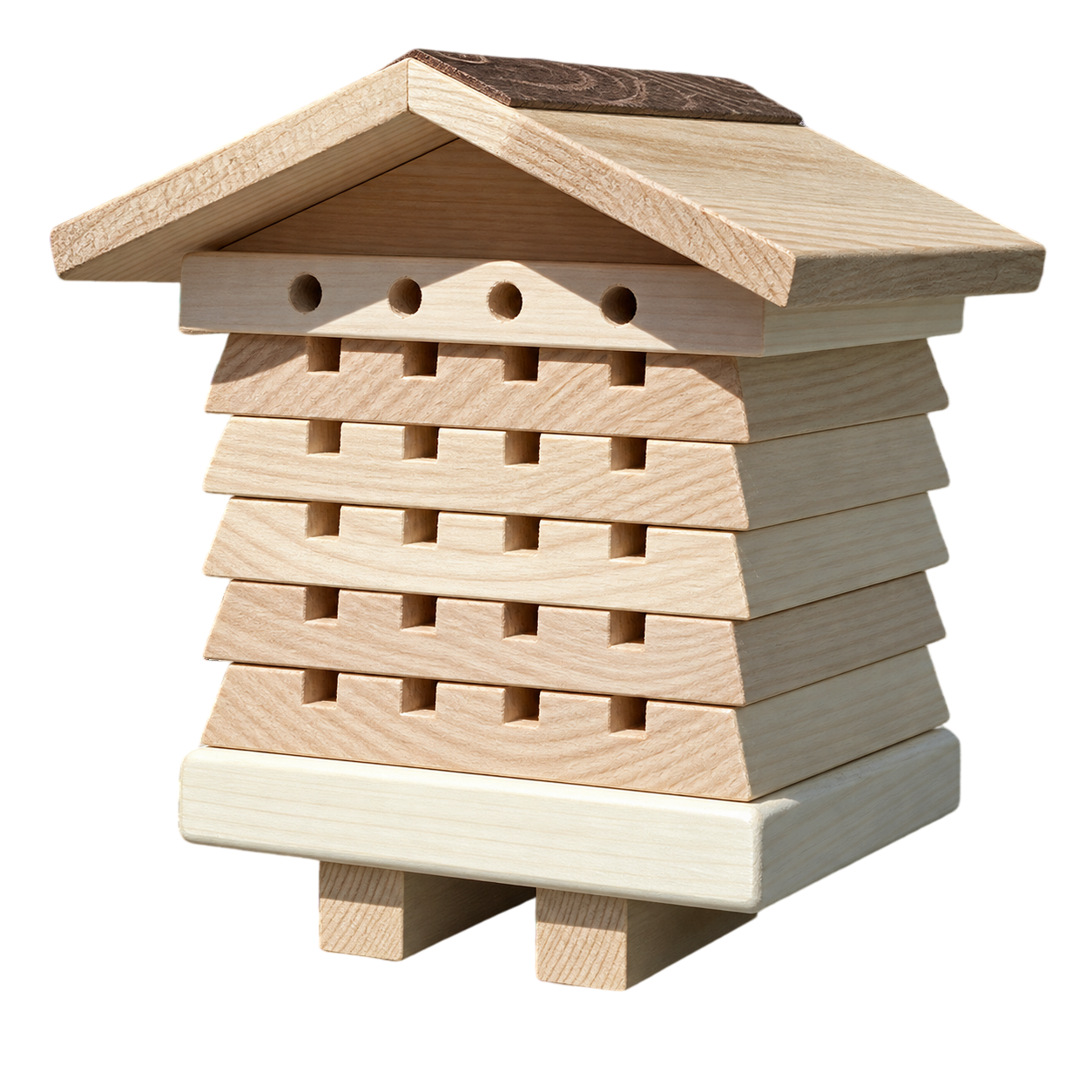
Red mason bees nest in ready-made cavities rather than digging their own, so a hotel with 8mm tunnels, a dry overhanging roof and a solid rear panel gives them exactly what they're already looking for each spring.
About Clayton Dawson
Cabinetmaker and solitary-bee keeper, and the maker of the Wild Bee Hotel. Clayton has kept red mason and leafcutter bees in his own garden for years, and every guide on this site is written and checked against what he sees in the tunnels each season rather than copied from a catalogue. Read the full story.
First published 22 September 2025 · last reviewed 30 July 2026.
What we based this on: Bumblebee Conservation Trust, Buglife, RHS.